Salesforce managed services: How to keep your platform stable, and ready to scale in 2026


Did you know that go-live is not the finish line for Salesforce? In many companies, it is the moment when the real work begins. New users join the business, sales, service, and marketing teams and ask for improvements. Automations become harder to manage. Salesforce releases also bring new features and changes that should be reviewed before they affect daily work. So, how can companies keep Salesforce under control after implementation? One practical answer is Salesforce managed services.
In this article, prepared with insights from Daniel Stanczak, Project Manager at Spyrosoft Connect, we explain what Salesforce managed services can include, which support models are available, and how this approach connects with broader Salesforce services for companies that want to improve Salesforce without building a large in-house team.
What are Salesforce managed services?
Salesforce managed services are ongoing support, maintenance, and improvement services for companies that already use Salesforce. They help businesses keep the platform stable after go-live, solve user problems faster, and continue improving Salesforce as teams, processes, and priorities change.
In practice, Salesforce managed services can include Salesforce admin support, development support, integration support, reporting improvements, automation updates, release readiness, user training, and long-term platform optimisation.
The main idea is simple: instead of treating Salesforce as a one-time implementation project, companies get a reliable support model for daily operations and future growth.
As part of this service, the client receives comprehensive, multi-faceted support. We can examine whether a given solution is good, how many people use it, and, if necessary, conduct appropriate training and familiarise users with the system’s capabilities.
Daniel Stanczak, Project Manager at Spyrosoft Connect
This is an important point because good Salesforce support services should not focus only on fixing technical issues. They should also help companies understand whether Salesforce is actually working well for their users.
For example, a company may have a custom sales process built in Salesforce. At first, it works well. But after a few months, users stop filling in some fields, managers complain about incomplete reports, and the sales team starts using spreadsheets again. In this case, managed services can help review the setup, check how users work with the system, improve the process, and provide additional training where needed.
This makes Salesforce managed services useful for companies that need more than occasional troubleshooting. They are especially valuable when Salesforce supports sales, service, marketing, operations, customer data, or integrated business processes.
Why Salesforce needs ongoing support after go-live
Even a well-implemented Salesforce org can become difficult to manage if no one owns its long-term health.
Small requests often appear one by one: a field needs to be changed, a report no longer shows the right data, a Flow needs an update, or an integration starts sending incomplete records. Each issue may look minor, but together they create a growing backlog and reduce trust in the platform.
This is the moment when ongoing Salesforce maintenance services become important. They help teams review requests, prioritise work, fix problems properly, and keep Salesforce aligned with real business processes.

For example, a customer service team may start manually reassigning cases because the existing routing logic no longer matches the team structure. At first, it feels like a small workaround. Later, it affects response times, reporting accuracy, and team performance. With regular Salesforce platform support, the issue can be reviewed earlier, the routing logic can be updated, and the process can be documented before it becomes a larger operational problem.
Ongoing support is also useful when a company is not sure whether Salesforce is still configured in the best way. In this case, a Salesforce Health Check can help identify configuration gaps, security risks, automation issues, and areas where users need a better experience.
Salesforce post-implementation support should not be treated as optional maintenance. It is part of keeping Salesforce reliable, user-adopted, and ready for future changes.
Salesforce managed services support models
There is no single support model that fits every Salesforce organisation. Some companies need help only when a specific issue appears. Others need a regular monthly capacity or a dedicated team that can manage the backlog, support users, and plan future improvements.
That is why Salesforce managed services should be flexible. The right model depends on the size of the Salesforce org, the number of users, the complexity of integrations, and how critical Salesforce is for daily operations.
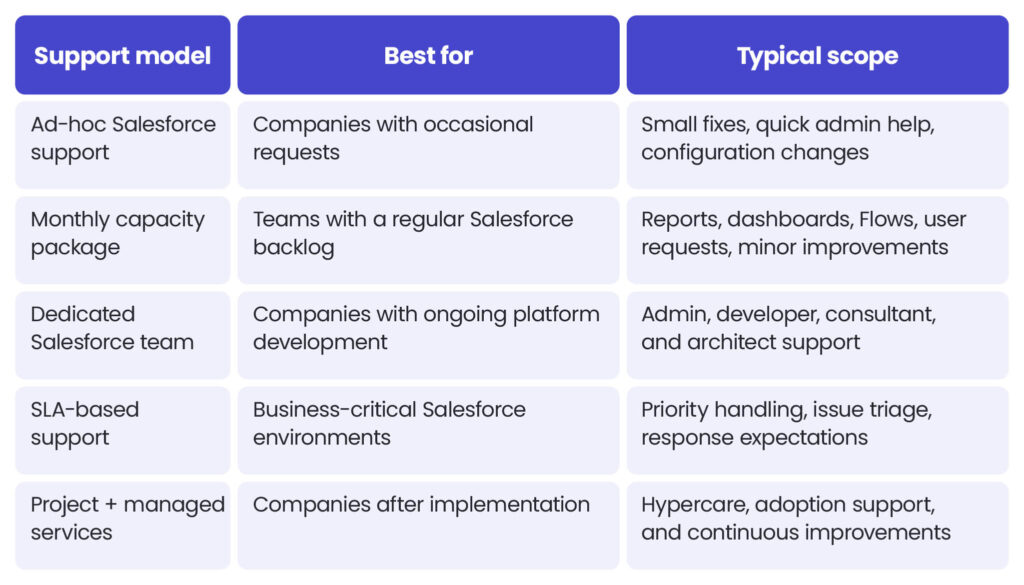
This model is useful when a company needs access to Salesforce expertise but does not want to hire every role internally. One month, the priority may be Salesforce admin support. Another month, the team may need Salesforce development support, integration fixes, or architectural advice.
Our company offers the option to purchase hourly packages for Salesforce managed services. The smallest package is 35 hours. Therefore, clients do not have to maintain employees and finance their training on Salesforce. They receive comprehensive support and full expertise from us. This approach allows our clients to reduce their business costs, while still having easy access to full-scale assistance both in Salesforce and other IT areas offered by Spyrosoft.
Daniel Stanczak, Project Manager at Spyrosoft Connect
A flexible Salesforce support partner can adjust the team and capacity to the actual workload rather than forcing the client into single fixed cooperation model.
What can be included in Salesforce managed services?
The exact scope depends on the company’s Salesforce setup and business priorities. Typically, managed services cover a mix of admin, development, integration, data, release, and user adoption support.
In most cases, Salesforce managed services cover several areas:
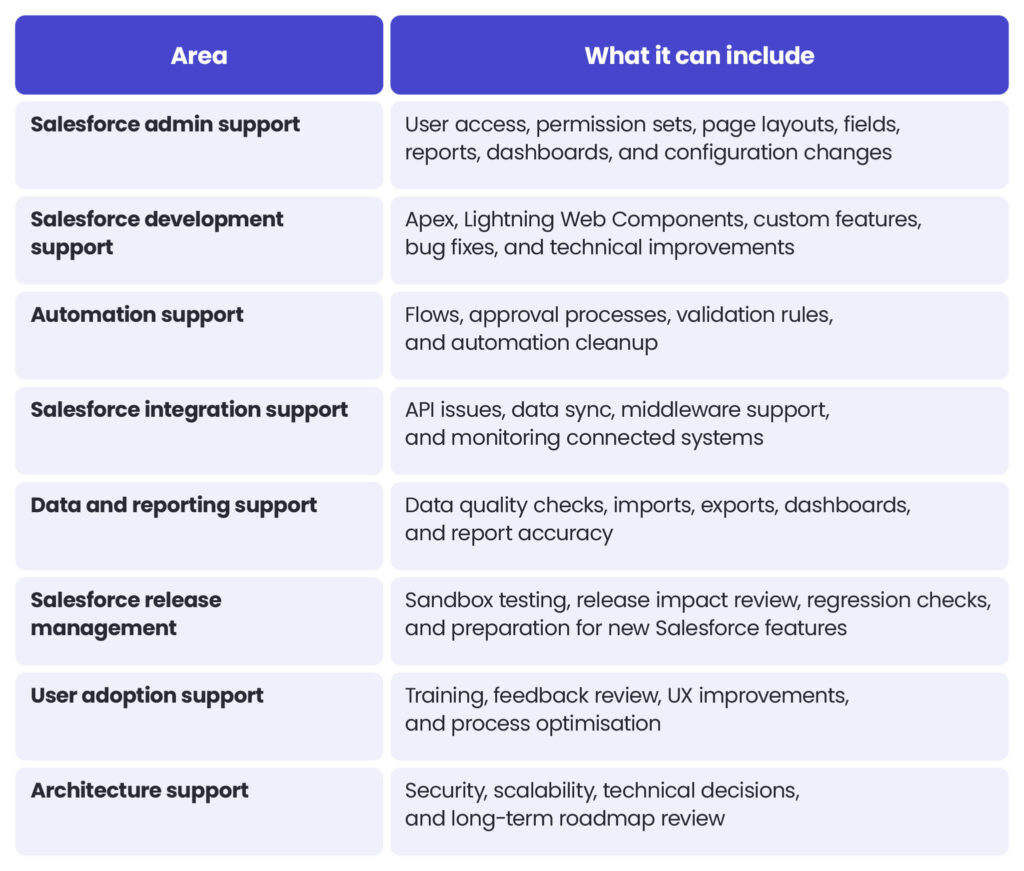
This type of Salesforce application support is especially useful when several departments use Salesforce. A small change in Sales Cloud can affect reporting. A new automation can influence Service Cloud processes. An integration issue can break data flow between Salesforce and another business system.
That is why managed services should not only close tickets. They should help companies understand how different parts of the platform work together. If your organisation uses several Salesforce products, it is also worth reviewing how different Salesforce cloud tools support your sales, service, marketing, and operational processes.
The goal is to keep Salesforce clean, connected, and useful for the people who work with it every day.
Business benefits of Salesforce managed services and how Spyrosoft can help
The business value of Salesforce managed services is not in the number of tickets closed. It is in making sure Salesforce continues to support real work after go-live.
When Salesforce is not reviewed regularly, small issues become normal. Users create workarounds, reports lose accuracy, and admins spend more time reacting to urgent requests than improving the platform. The system may still be available, but it becomes harder to trust.
A good Salesforce support partner helps prevent this. The focus is not only on fixing what is broken, but also on understanding why the issue appeared and how to solve it in a cleaner way.
As Daniel Stanczak, Project Manager at Spyrosoft Connect, explains:
Initially, it is important to identify problems, propose the most accurate solutions and conduct comprehensive optimisation of services. It involves listening to the client, discussing the details of the actions the client expects.
This is an important part of managed services. Before making changes, the team should understand the business context, user needs, and possible impact on other Salesforce processes.
For companies, this brings several practical benefits:
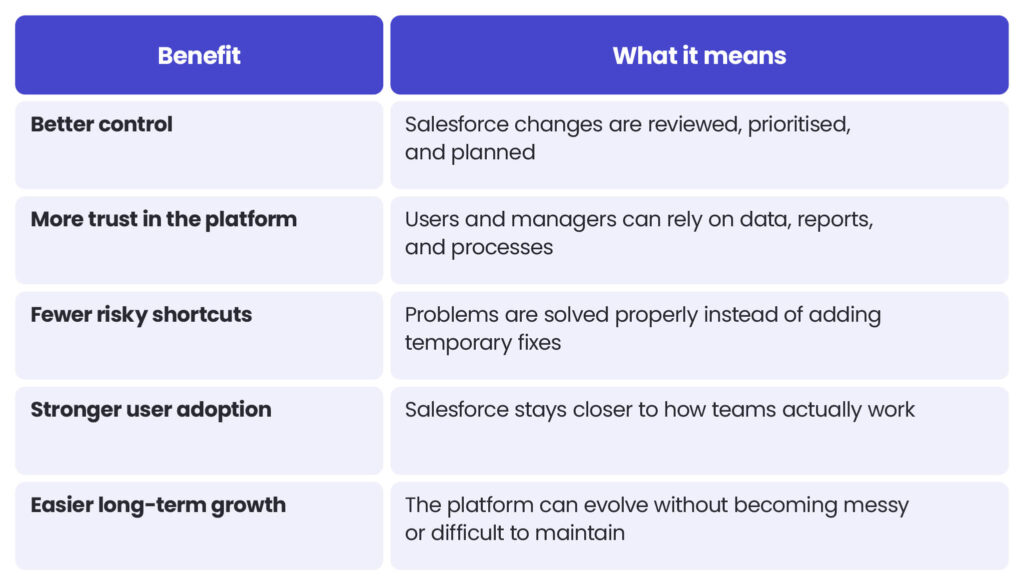
At Spyrosoft, this approach can also continue naturally after implementation. If the same team already understands the client’s Salesforce setup, business goals, and technical decisions, future support becomes more consistent and easier to organise.
For more complex environments, especially those with several vendors, clear ownership is even more important. In multivendor Salesforce delivery, managed services can help keep communication, responsibilities, and change management under control.
In Conclusion
Salesforce managed services help companies protect the value of Salesforce after go-live. They give teams a clearer way to manage support, improve the platform, and keep Salesforce aligned with business priorities.
In 2026, this is especially important. Salesforce environments are becoming more connected, automated, and business-critical. Without regular support, even a well-built org can become difficult to maintain.
The right Salesforce managed services provider can help your team move from reactive fixes to planned improvement, with the right mix of admin, development, integration, release, and advisory support.
If your Salesforce backlog is growing, your internal team needs extra capacity, or your platform needs a clearer support model, explore our Salesforce services and see how Spyrosoft can support your next stage of Salesforce growth.
FAQ
Salesforce managed services are ongoing support, maintenance, and improvement services for companies that already use Salesforce after go-live.
A company may need them when the backlog is growing, users wait too long for support, reports are unreliable, integrations need attention, or the internal team lacks Salesforce capacity.
They can include admin support, development, integrations, reporting, automation updates, release readiness, user training, and platform optimisation.
Yes. They can include Apex, Lightning Web Components, custom features, bug fixes, and integration improvements.
Spyrosoft offers flexible hourly packages, providing access to specialists across various areas like UX, architecture, and troubleshooting. Each project gets experts best suited to the client’s needs. The collaboration process is simple, transparent, and can easily expand to other IT services.
They help teams move from reactive fixes to planned improvement by reviewing priorities, managing changes, supporting users, and preparing Salesforce for future growth.
Yes. Salesforce offers rich API capabilities, allowing integration with communication, marketing, payment, and reporting tools like Slack, Zoom, or Outlook. These integrations streamline workflows, automate tasks, and enhance collaboration across your organisation.


arrow_circle_rightContact us
Our experts will help you implement and tailor Salesforce to your needs

Michal Gronowski
Head of CRM Systems
arrow_circle_right our articles