AI defect detection in manufacturing: how root cause analysis software solves the scrap rate problem

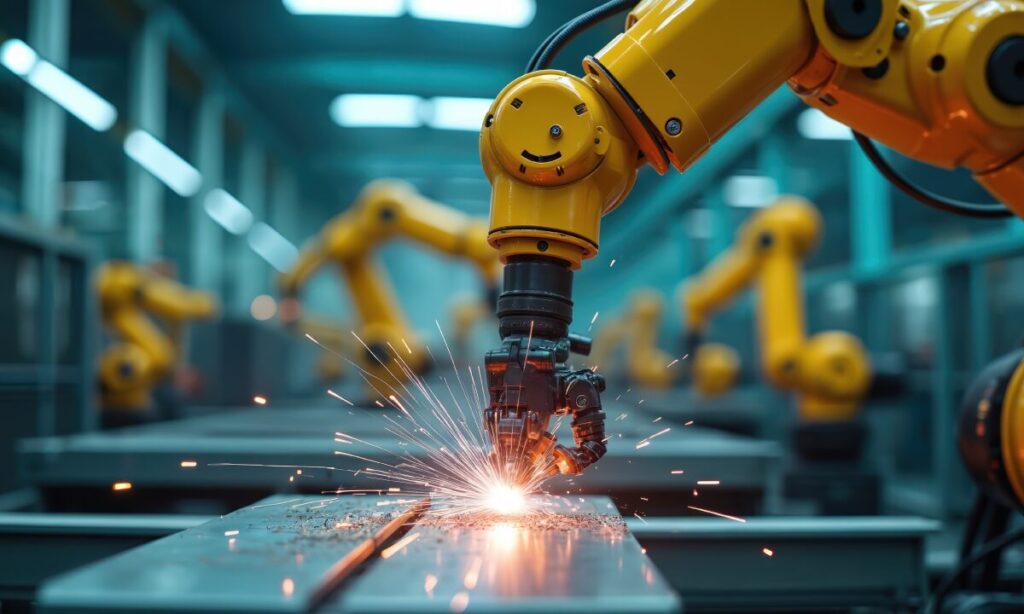
Even in stable production environments, quality defects still occur – and most manufacturers cannot fully explain why. AI root cause analysis software solves this by linking process data to quality outcomes and identifyingthe conditions that cause defects before they recur. This article explains why traditional defect detection has structural limitations and how Spyrosoft’s AI-powered solution closes the gap.
The cost of manufacturing defective products
The instinct in most organisations is to treat a stable, low defect rate as an acceptable cost of doing business. The numbers suggest this instinct is significantly underpricing the problem.
When the full impact of manufacturing defects is calculated, the total can reach up to 20% of total sales revenue.
That figure surprises most people the first time they encounter it. The reason it is not more visible is that defect-related costs are distributed across multiple budget lines rather than appearing as a single item. Scrapped materials sit in the production budget, disposal costs sit in logistics, downtime during defect investigations sits in operations, and customer escalations sit in account management. Nobody is adding them up.
Where defect costs actually accumulate
- Wasted resources: every unit with product defects consumed raw materials, machine time, and energy that could have produced a sellable product. The loss contains everything that went into producing the unit.
- Discarding costs: faulty products require sorting, storage, and disposal. In regulated industries like food, chemicals, or medical devices, each step involves documented processes. These costs are real and recurring.
- Unmet delivery schedules: defect spikes trigger investigations which slow or stop production lines. While your quality team is looking for answers, your clients are waiting for orders. The reputational cost of this rarely appears on a balance sheet. It shows up later, in contract renewals.

The consequences? Double loss, production downtime, and customer dissatisfaction.
AI defect detection can reduce costs by automatically identifying product defects before they progress further in the manufacturing process. Implementing them helps manufacturers achieve significant financial savings by preventing defective products from reaching customers.
Why traditional Quality Control cannot solve the defect problem
Quality control systems have improved significantly over the past two decades. The tools are more sophisticated than ever: automated optical inspection, statistical process control, end-of-line testing. And yet the defect problem persists.
The reason is: traditional Quality Control is designed to identify which products have failed, not to explain why – and not to prevent the next one.
Traditional visual inspection and manual inspection methods are limited by human error and subjectivity, especially in high-volume production environments.
Current solutions zoom in on individual products at specific checkpoints, typically at or near the end of the production process. What they lack are the tools to see the big picture: the full process, across every unit, connected back to the conditions that produced each outcome.
By the time a defect is flagged, the conditions that caused it have already affected dozens, hundreds, or thousands of units. The root cause (like a temperature drift upstream, gradual tool wear, or a batch variance in incoming materials) remains invisible.
There is a second, equally important limitation: the data that could explain root cause already exists in most facilities – it just isn’t connected.
Sensor readings, production logs, equipment telemetry, and QA outputs are being generated continuously. But they typically live across separate systems that do not communicate with each other in a structured way. Production data and quality data use different identifiers and are rarely linked at the unit or batch level.
The crucial gap is between process monitoring and quality outcomes, and closing it requires a fundamentally different kind of system.
The Spyrosoft solution: AI root cause analysis software
We built Spyrosoft’s AI root cause analysis software specifically to address this gap.
Unlike traditional QC systems that inspect products, Spyrosoft’s software monitors the entire manufacturing process – continuously, across every unit, not just sampled ones. It connects existing sensor and production data to quality outcomes, identifies the conditions that precede defect occurrence, and alerts production teams before issues escalate.
The move it enables is from a fragmented, product-focused view based on spot checks, to a holistic overview of the entire process.
Critically, this does not require new sensors or rebuilt data infrastructure. The system almost always already generates the data it needs. What Spyrosoft provides is the architecture to connect it and the analytical engine to make it meaningful.
How AI root cause analysis software works
The software operates across four connected layers, each building on the last.
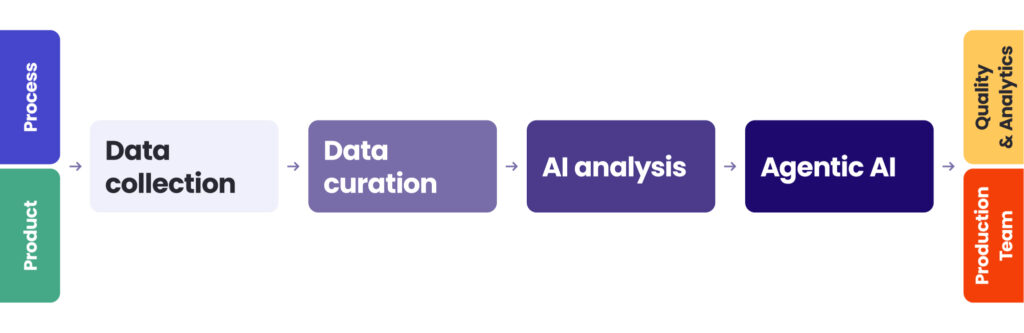
Layer 1: Data collection
Modern production environments generate substantial data – sensor readings, production logs, metadata, QA system outputs, defect records. In most facilities, this data exists but is fragmented across systems and rarely linked to quality outcomes in a structured way. The first layer aggregates it from both process and product sources, aligned by timestamp. Edge devices often enable real-time data collection and processing in manufacturing environments, which supports immediate detection and analysis for AI-based defect detection systems.
Layer 2: Data curation
Raw manufacturing data is inherently messy – missing values, inconsistent formats, signal noise. This layer standardises and unifies the data, eliminates noise, and links process parameters to QC results at the batch or unit level. This linkage is what most in-house analytics approaches fail to achieve. Without it, root cause analysis is not possible.
Layer 3: AI analysis
With clean, linked data, statistical methods and machine learning are applied to model the relationship between process variables and defect occurrence. This surfaces multi-variable patterns (correlations across temperature, pressure, speed, tooling, material inputs) that are invisible to manual analysis. Root cause stops being a hypothesis and becomes a data-supported finding.
Layer 4: Agentic AI
The final layer moves from analysis to action. The system interprets results in context, provides human-readable explanations of findings, and proactively suggests specific process adjustments to prevent recurrence. This is where agentic AI in manufacturing delivers its clearest value: not just identifying what happened, but guiding what to do next.
Business impact: what changes when you prevent defects at the source
A well-implemented AI-powered root cause analysis system produces measurable changes across the production operation.
Taken together, these outcomes represent savings of up to 20% of annual revenue, recovered from losses that most operations have come to treat as unavoidable.

Lower scrap rates
It’s typically the most immediate and measurable outcome. Teams produce fewer units under defect-causing conditions before they identify and correct those conditions.
Shorter investigation times
When the system surfaces the root cause within minutes rather than days, production teams spend less time diagnosing and more time producing.
Improved OEE (Overall Equipment Effectiveness)
It results from reduced unplanned downtime and more predictable production runs. When teams continuously monitor process conditions and catch anomalies early, they can keep interventions smaller and less disruptive.
Better customer satisfaction
Perhaps the most strategically significant outcome. Consistent quality, reliable delivery, and fewer client-side defect escalations compound into a stronger supplier reputation over time.
Accumulation of process knowledge
One underappreciated benefit: over time, the system builds a documented record of which process conditions cause which defects. This knowledge persists through staff turnover and informs future process design decisions.
AI defect detection real-world uses cases across industries
The same underlying architecture applies across manufacturing sectors, with the system trained on industry-specific parameters and defect types.
Window & Glass Manufacturing
Common defects include bubbles and inclusions, micro-cracks from annealing, optical distortions, coating failures, and thermal stress cracks. Surface level defects, such as scratches or blemishes on the surface of glass products, are detected through AI visual inspection using imaging and deep learning techniques during real-time quality control processes. AI defect detection systems can identify both surface defects, which are visible to standard cameras, and internal or structural defects, which require specialised imaging equipment.
The AI monitors furnace temperature, annealing zone conditions, glass thickness variation, roller pressure and speed, and ambient humidity during IGU assembly. It correlates defect clusters with temperature or speed drift, predicts defect onset based on tin bath stability, and alerts when roller wear is beginning to create wave patterns – before they appear in finished product.
Food & Beverage Production
Defects in this sector (such as color and texture deviations, seal failures, contamination, undercooked batches, spoilage) are particularly costly given shelf life constraints and regulatory exposure. The system monitors oven temperature and humidity, fill weight sensors, seal temperature, vision QC images, and cold chain temperature history. It detects underfill and seal drift in real time, identifies contamination source patterns, and predicts shelf life based on temperature exposure across the production and distribution chain.
Stop defects before they start – with our AI software
Learn more
Semiconductor & Chip Manufacturing
In high-value, high-complexity semiconductor production, yield excursions carry extreme financial consequences. The AI system ingests in-circuit test results, cleanroom particle counts, AOI images, wafer defect maps, and solder paste volume data. It predicts yield excursions before the test stage, classifies wafer defects in milliseconds, flags when equipment maintenance is due, and identifies multi-stage correlation patterns that no human inspectors could reasonably track.
Metal Casting & Machining
Weld gaps, wall thickness variation, porosity in castings, thread misalignment, and surface finish degradation are monitored via welding parameters, casting temperature, CNC tool usage cycles, and ultrasonic inspection logs. The system flags parts at risk when mold temperature and tool cycle thresholds are approached, triggers proactive tool changes before thread quality begins to degrade, and adjusts cutting parameters to maintain surface finish within spec.
Plumbing Products Manufacturing
For cast and machined plumbing components, the system monitors welding current and voltage, extrusion temperature and pressure, hydrostatic test data, and casting temperature within the 900-940°C range. It predicts leak probability before the QC stage, flags combination conditions (mold temp + tool cycles) associated with elevated defect risk, and supports faster certification and release to ship.
Chemical Manufacturing
Batch consistency is the central quality challenge in chemical production. Off-spec batches, catalyst degradation, side reactions, cross-contamination, and viscosity deviations are monitored via reactor pressure and temperature, catalyst concentration, pH measurements taken at 60-second intervals, and raw material certificates of analysis. The AI identifies root causes of impurity spikes, predicts yield drops before batch completion, and suggests specific adjustments to feed ratios and temperature setpoints.
Why agentic AI is the future of Quality Control in manufacturing
With agentic AI, systems no longer just analyse, but guide decisions and actions in real time.
| Traditional Quality Control | AI-driven defect detection | |
| Approach | Detects defects | Prevents defects |
| Posture | Reactive | Predictive |
| Root cause | Manual investigation | Automated identification |
| Rules | Static | Adaptive machine learning |
| Visibility | Limited, product-level | Full process visibility |
| Scope | Sampled units | Every unit |
Ready to reduce your scrap rate with AI-based defect detection?
Spyrosoft has built AI defect detection and root cause analysis systems for manufacturers across industrial sectors – from glass and food production to semiconductor fabrication and precision metal casting.

Our team brings deep IoT expertise, cross-industry experience, and AI & Data Science capability recognised by industry leaders including Viessmann, Siemens Energy, Panasonic, Zeiss, and Magna.
If you’re dealing with persistent quality issues and want to understand whether your existing process data could be doing more work, it’s worth a direct conversation. Contact us to discuss your production environment.
FAQ: AI defect detection in manufacturing industry
AI defect detection uses artificial intelligence, including computer vision systems, to automatically identify product defects in real time. Unlike traditional human inspection, artificial intelligence can monitor every unit and detect hidden or internal defects before they escalate.
Human inspection is limited by subjectivity and fatigue, especially in high-volume production. AI-driven systems use computer vision and sensor data to find subtle or internal defects that often go unnoticed, ensuring higher product quality.
Artificial intelligence can detect surface-level defects, like scratches or color deviations, and internal defects, such as structural faults in metal, glass, or semiconductor products. Computer vision systems combined with process data help identify both visible and hidden defects across industries.
Unlike manual human inspection or sample-based QC, AI provides continuous monitoring of the entire production process. This ensures defects are detected early, root causes are identified, and process adjustments are automated – leading to consistent product quality.
No. AI systems typically use existing production and sensor data. What’s required is software that connects these data sources, cleans and analyses the data, and applies AI models for automated defect detection.
Computer vision AI systems capture detailed images of products and analyse them in real time. Combined with process data, they can identify patterns that indicate internal defects or anomalies not visible to the human eye.




arrow_circle_rightContact us
Reach out to our expert to discuss your project

arrow_circle_right Our articles


![[industry 4.0] how IoT monitoring is revolutionising grocery cold chains (and cutting costs)](https://spyro-soft.com/wp-content/uploads/2025/10/adobestock_845811382-2-scaled-1-1024x512.jpeg)