Choosing a B2B ecommerce platform for strategic business growth – what to consider before implementation?


The B2B sales market is undergoing rapid digital transformation. Companies must adapt to rising customer expectations and fast-paced technological change, in a landscape where many organisations still lack a solid foundation, such as a modern B2B ecommerce platform.
Today, business clients expect a shopping experience similar to that of B2C: immediate access to product ranges, straightforward ordering processes and full self-service. At the same time, companies are under pressure to optimise operating costs and automate sales processes. As a result, the B2B platform is no longer merely an ‘add-on’ to sales, but is becoming its core, which is also often a customer requirement.
That is why in this article, we focus on providing a practical decision-making framework and outlining the key criteria for selecting a B2B ecommerce platform, so that it is easier to align available technology with the organisation’s chosen business strategy.
Why is choosing a B2B platform a strategic decision, and not just a technical one?
The choice of a B2B ecommerce platform directly influences the way an organisation sells, serves its customers and scales its business. It is a decision that can affect a company’s operations for years to come, which is why it should be analysed in the context of business strategy, rather than solely in terms of the system’s functionalities.
The technological aspects of choosing a platform are, of course, important, but they should only account for a fraction of the decision. Technology alone cannot be the starting point; however, it is worth remembering that it is a key factor that may determine the success of the entire venture. It is often technology that determines how effectively and how quickly an organisation can translate business objectives into tangible operational activities.
Therefore, it is crucial that technology supports a pre-established strategy, rather than defining or altering it. When selecting a platform, the focus should be on the company’s actual needs and decisions regarding its future development, such as: do we plan to expand into new markets? Are we opening up to new customer segments or sales channels (B2C, D2C)? It is only within this broader context that the choice of a B2B ecommerce platform takes on its true significance and can genuinely support the achievement of long-term objectives and positively impact business metrics.
Cost of order acquisition and processing
A B2B platform changes the sales cost structure. Thanks to self-service, customers can place orders, check statuses, generate bids, and download necessary documents and invoices themselves, thereby reducing the involvement of sales representatives and the customer service department. At the same time, the automation of processes – such as order validation, discount calculation and payment processing – reduces errors and operational costs. In practice, a well-chosen platform allows you to handle a higher volume of orders without a proportional increase in staff numbers.
Time-to-market for new markets and channels
A modern ecommerce platform enables the rapid launch of new languages, currencies or product catalogue versions, which is crucial for international expansion. Equally important is the ability to test new sales models, e.g., transitioning from an offline to a hybrid model or launching direct-to-consumer (D2C) sales. A platform with limited capabilities can significantly slow down these activities, resulting in missed market opportunities.
TCO (Total Cost of Ownership) over a 3–5 year period
The cost of a platform is more than just the licence fee. You must take into account the costs of implementation, integration, development of new features, infrastructure maintenance, updates and technical support. For some solutions, costs rise in line with the scale of the business (e.g., licence fees), which can affect profitability. Therefore, a TCO analysis should cover realistic growth scenarios, not just the organisation’s current state.

Ability to integrate with systems (ERP, PIM, WMS, marketing automation)
A B2B platform rarely operates as an isolated system; it is usually part of a larger technological ecosystem. Integration with ERP handles the synchronisation of orders, stock levels and settlements; PIM manages product information; WMS supports logistics; and marketing automation tools enable personalised communication. If the platform does not offer flexible APIs or requires costly, bespoke integrations, it can quickly become an operational bottleneck.
The cost of making the wrong choice and the risks of replatforming
Changing platforms after a short period of time (replatforming) is one of the most expensive undertakings in ecommerce. It involves not only technological costs (new implementation, data migration, integrations), but also business risks: drops in conversion rates, operational downtime, loss of organisational knowledge, or the need to retrain teams. Therefore, the decision on which platform to choose should minimise the risk of having to change it for at least the next few years.
Choosing the wrong B2B ecommerce platform can be very costly for a company, both financially and in operational and strategic terms. The implementation of a B2B platform alone is usually a process lasting several months, which requires mapping the company’s individual processes and integration with ERP, WMS, PIM or even PLM (Product Lifecycle Management) systems. The problem arises when, for example, a company changes its strategy after a year – it begins to develop a B2C or D2C sales model, expand abroad, or launch new brands following acquisitions.
It may then turn out that the platform, which initially met the requirements, begins to hinder business growth. This often leads to the need for replatforming, meaning another costly implementation lasting up to six months. Therefore, the decision on which technology to choose should take into consideration not only current needs, but also the company’s strategy and development plan for the next 3–4 years.
An overview of B2B ecommerce platforms
In the B2B ecommerce platform market, there is no single solution that is ideal or optimal for every business scenario. Each platform is developed differently, has its own pros and cons, and addresses different organisational needs. Some focus on flexibility and an extensive ecosystem, whilst others prioritise ready-made, built-in functionalities or speed of implementation.
Therefore, rather than searching for the ‘best’ platform, it is worth understanding its strengths and limitations, as well as the business context in which they work best. Only this knowledge, combined with an analysis of processes, needs and development plans, will help you choose the platform that best suits your business objectives.
Magento Open Source
Magento is one of the most recognisable and widely used ecommerce solutions in the world. Its greatest advantage is its maturity, which translates into a vast number of developed modules, agencies, implementation partners and specialists available on the market.
Although it is not a native B2B platform, thanks to its extensive community and ecosystem of ready-made extensions, it allows for the quick implementation of new features tailored to complex sales processes and business operations. This platform offers considerable scope for customisation, which is why it is particularly popular among companies that require a high degree of flexibility and control over the code.
At the same time, this very flexibility can become a challenge. Magento projects often evolve into highly customised solutions which, after a few years, may deviate significantly from the platform’s standard core. This can result in higher maintenance costs and difficulties in further development.
- Licensing model: open source (no licence fees; implementation and maintenance costs on the company’s side)
- Architecture: monolithic with the option of a headless approach
- Out-of-the-box B2B capabilities: limited; most features (e.g., contract pricing, workflow) require extensions
- Integration and extension ecosystem: very extensive, with thousands of modules available
- Community and expertise (PL/EU): very broad – high availability of developers and agencies

Adobe Commerce
Adobe Commerce is a licensed solution that extends the capabilities of Magento, aimed primarily at the enterprise sector. It offers extensive B2B functionalities, support for global organisations, and integrations with Adobe tools. The platform combines the flexibility of Magento with additional modules and vendor support, enabling large companies to build a cohesive digital environment.
However, it is worth remembering that as the scope of functionalities increases, so do complexity and maintenance costs. Adobe Commerce works best where an organisation is ready to invest not only in technology but also in the processes and expertise needed to fully utilise the platform’s potential.
- Licensing model: proprietary (paid licence, often dependent on business scale)
- Architecture: modern, headless-ready, evolving towards composable commerce
- Out-of-the-box B2B: highly comprehensive (customised price lists, company structures, approval workflows)
- Integration and extension ecosystem: robust, supported by Adobe and partners
- Community and expertise (PL/EU): extensive, though more specialised and costly
Shopware 6
Shopware 6 is a modern ecommerce platform developed using an API-first approach, which is gaining popularity, particularly in Europe. It combines technological flexibility with increasingly sophisticated B2B functionalities.
Shopware develops a significant portion of its features directly within the platform’s core, thereby reducing the need to rely on external modules. This allows organisations to take advantage of new capabilities sooner without having to integrate multiple extensions. In practice, this translates to a favourable price-to-quality ratio.
A notable advantage of Shopware 6 is its strong focus on tailoring solutions to the regulatory and business realities of the European market. The platform responds swiftly to changes arising from EU directives and regulations (e.g., in the area of price transparency), implementing tailored solutions within its core. For businesses, this means a reduced need to build their own bespoke solutions in this area.
- Licensing model: hybrid (open core + paid modules)
- Architecture: API-first, headless-ready, based on a modern technology stack
- Out-of-the-box B2B: moderate – available via extensions (e.g., B2B Suite)
- Integration and extension ecosystem: growing rapidly, particularly in Europe
- Community and expertise (PL/EU): growing, with an increasing number of partners in Poland

OroCommerce
OroCommerce is a platform designed from the ground up for B2B sales. Its main advantage is its ability to handle complex business processes without the need for extensive customisation. Many features that would require significant development on other platforms are available here immediately upon implementation. In many cases (assuming the company doesn’t have highly complex processes), a well-executed configuration can meet a significant portion of the organisation’s needs without the necessity of further intensive development.
An additional advantage of the platform is its built-in CRM module, which supports sales teams’ work. In addition to its embedded features, the platform also offers customisation options. However, it should be mentioned that this platform is still smaller than other, better-known solutions on the market – it is constantly evolving and is only just gaining popularity. This results in a limited availability of implementation partners, specialists or ready-made integration solutions.
- Licensing model: open source + enterprise version
- Architecture: API-first, modular, designed for integration with business systems
- B2B out-of-the-box: very strong (quoting, organisational structures, workflow, advanced user roles)
- Integration and extension ecosystem: smaller than Magento’s, but more specialised
- Community and expertise (PL/EU): still quite small, but focused on B2B projects
Criteria for choosing a B2B platform
The selection of a B2B ecommerce platform should be based on how well it aligns with the organisation’s specific characteristics, processes, and development plans. The criteria below help to structure the analysis and set the correct priorities.
Alignment with the sales model (self-service, assisted, hybrid)
Every B2B organisation has a different approach to sales. In the self-service model, user convenience and automation are key, whereas in the assisted model, the role of the sales representative remains significant (e.g., in the quotation or negotiation process). In the hybrid model, both approaches coexist. The platform should support the chosen model without the need for major modifications, e.g., by enabling the assignment of account managers, bid management, or sharing the shopping basket between the customer and the sales representative.

Support for multiple markets, currencies, languages, and warehouses
International expansion requires flexible management of different versions of the offering. The platform should enable the creation of multiple storefronts, support for different currencies, handling of local taxes and regulations, and integration with multiple warehouses. It is also essential to manage differences in product ranges and pricing across markets.
Depth of personalisation (UI, pricing logic, processes)
In B2B, personalisation goes beyond the interface’s appearance. It includes, among other things, individual price lists, contract discounts, payment terms, and specific purchasing processes (e.g., multi-level order approval). The platform should allow for flexible modelling of these elements without the need to create custom code each time.
Integration readiness (ERP, PIM, CRM, payments, logistics, etc.)
The availability of APIs and ready-made integration connectors is essential when making a choice. The platform should provide support for system integration and enable efficient, real-time or near-real-time data exchange between systems. It is also worth assessing whether integrations can be implemented in a scalable manner or whether every change requires modification of the platform’s code.
Technical and cost scalability
The platform should be able to handle growing traffic, user numbers, and order volumes without any drop in performance. Cost scalability is equally important: does business growth lead to a disproportionate increase in licence, infrastructure, or maintenance costs? It is worth analysing various growth scenarios and their impact on the budget.
Vendor lock-in vs. technological sovereignty
Some platforms restrict the ability to modify the code or make the company dependent on a single supplier (vendor lock-in). Others, particularly open-source platforms, offer greater control but require more technical expertise. The choice should take into account the long-term strategy: does the company wish to build its own technological capabilities, or can it rely on external suppliers?
Implementation time and cost (MVP vs. end-state solution)
In practice, B2B ecommerce platform implementations are often carried out in stages. The key factor is whether the platform enables a fast MVP (Minimum Viable Product) launch, allowing you to start generating business value, followed by iterative development of features. It is also important to assess whether the system architecture supports such an approach or requires significant upfront investment.
One of the most frequently underestimated aspects of platform implementation is pricing and the logic behind assigning prices to customers. Companies often assume that a simple division into customer groups is sufficient, but in practice, it turns out that there are many exceptions, individual conditions, or special rules for specific product categories. It is only during the pre-implementation analysis that the true complexity of pricing processes comes to light. This often results in price lists being simplified right at the platform implementation stage, as the previous models were too complex to manage effectively.
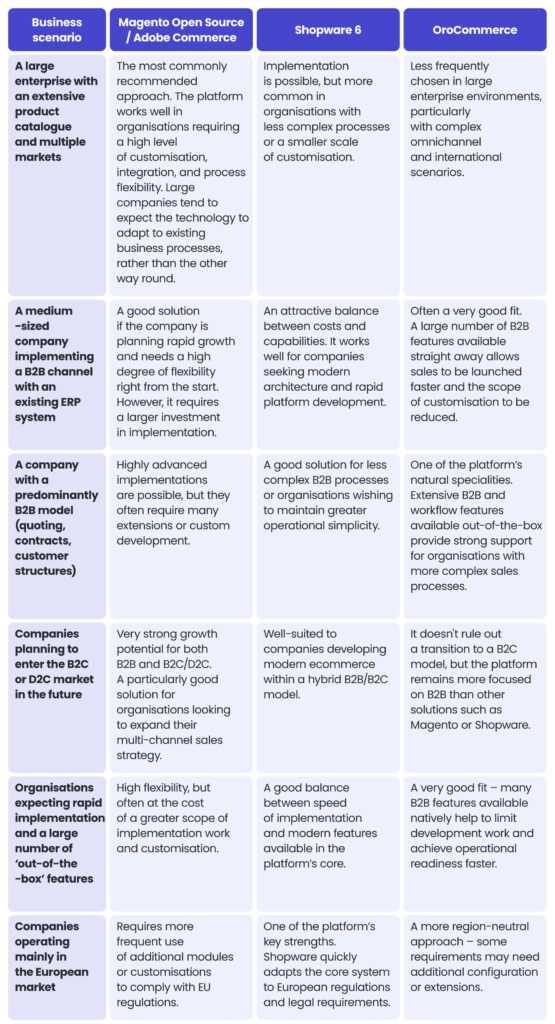
Matching the platform to the business scenario
The choice of a B2B ecommerce platform should be based primarily on the organisation’s business context – its processes, scale of operations, development plans, and level of readiness for change. In practice, there are certain scenarios in which specific platforms are more often the right choice, but these are not set-in-stone rules. The final decision should be preceded by an analysis of the company’s requirements, processes, and development strategy.
Checklist before choosing a B2B ecommerce platform
Before deciding on a B2B ecommerce platform, it is worth going through a set of questions that help clarify core business, technical, and operational requirements. Such an analysis often helps avoid costly mistakes already at the planning stage of implementation.
1. Business strategy, development and project objectives
- Do you know what business challenges the implementation of a B2B ecommerce platform is intended to address?
- What are the organisation’s strategic plans and growth ambitions for the next 3–5 years?
- Have you defined the business objectives and KPIs that the platform is expected to meet?
- Are you planning international expansion or entering new sales channels (e.g., B2C, D2C)?
- Is the platform intended to support multiple languages, currencies, markets or warehouses?
- Are you more concerned with a quick MVP launch (and subsequent expansion) or with building a final, scalable solution?
- Should the platform allow for phased development and expansion of functionalities over time?
- How important is it to be able to quickly adapt the platform to legal changes and regulations?
2. Sales processes and technological readiness
- Have you defined your customers’ purchasing processes?
- Are the ordering processes documented and repeatable?
- What does the current order placement and fulfilment process look like?
- Is the handling of complaints and returns standardised?
- Which platform functionalities are key to your business?
- Which system integrations are critical on go-live day?
- Do you have any expectations regarding AI and automation, and if so, what are they?
- How important is the ability to further customise the platform to you?
3. Data, products and information organisation
- Do you have a standardised product database (PIM or equivalent)?
- Are customers’ and suppliers’ data centralised in an ERP or CRM system?
- Are price lists and terms and conditions organised and managed digitally?
- How large and complex is the product catalogue?
- Do products have variants, configurations or dependencies?
- How often are product data, prices, and availability updated?
- Are logistics and stock levels managed by a system?
4. Budget, resources and project organisation
- What resources do you intend to allocate to the implementation, maintenance, and development of the platform?
- Do you have a defined approximate budget and implementation schedule?
- Does the projected TCO (licence + implementation + maintenance + development) for the next 3 years fit within your financial capabilities?
- Do you have in-house technical expertise, or do you need an implementation partner?
- Do you have a dedicated team responsible for the project within your organisation?
- How important is the availability of developers and implementation partners in the market to you?

Benefits of implementing a B2B platform
The benefits of implementing a B2B ecommerce platform may vary depending on the organisation’s specific nature, sales model, or stage of digital transformation. For some, the key KPI will be an increase in online orders; for others, it will be reducing customer service times, improving lead conversion rates, or reducing the number of errors and complaints. Therefore, the effectiveness of the implementation should be assessed primarily in the context of the organisation’s business objectives that the platform is designed to support.
Reduction in operating costs
Order automation reduces the workload on sales and customer service departments. Customers can place orders, check statuses, and download documents themselves without having to contact a sales representative or the back office.
In practice, the automation of after-sales service also generates significant savings. Invoices, corrections, delivery notes, and order history are accessible directly on the platform, significantly reducing the number of calls and messages regarding simple administrative tasks. This not only reduces costs but also speeds up customer service and enhances the convenience of cooperation.
Shortening the sales cycle
Customers can place orders and generate quotes themselves without having to contact the sales department. This is particularly important in situations where purchasing decisions are made outside standard business hours.
In practice, a B2B ecommerce platform often streamlines the process even before the order is formally placed. The customer does not have to wait to be contacted by a sales representative; they can place an order immediately, confident that it will be processed the next working day. This builds convenience and a habit of using the online channel, which directly contributes to an increase in the number of orders processed through the platform.
Increased cart value
Cross-selling and up-selling mechanisms also work in the B2B model. The platform can recommend complementary products, remind customers of regularly purchased items, or present individual pricing terms for a specific customer.
Better customer retention
Personalisation and convenience boost loyalty. Today’s business customers expect not only an attractive offer, but also a fast, convenient, and predictable purchasing process. The ability to place orders at any time, along with quick access to order history, documents, and individual purchase terms, makes the platform a natural channel for business cooperation.
Data as a competitive advantage
The platform provides information on customer behaviour that can support sales and marketing strategies. Organisations can analyse, e.g., the frequency and volume of orders, as well as the effectiveness of offers, promotions, and individual price lists. In the long term, this data enables not only the optimisation of the sales process but also the faster identification of operational issues, such as sources of complaints, process errors, or areas that generate unnecessary losses or costs.
The final step: Choose a B2B platform and an implementation partner
There is no single ‘best’ B2B ecommerce platform. But there can be a solution best suited to your business model, processes, and growth ambitions. That is why choosing a platform should be the result of strategic analysis, rather than merely a technological decision or a comparison of feature lists.
The key to success is:
- understanding your own business needs,
- a realistic assessment of resources and constraints,
- choosing a technology that supports your strategy, rather than defining it.
In practice, this means moving away from thinking “which platform should we choose?” towards asking: “which platform should we choose to achieve our business goals over the next 3–5 years?” Only with this foundation in place, you can make an informed assessment of which direction is better – a more flexible and customisation-friendly solution, or a platform offering a greater number of features available immediately upon implementation.
If you are planning to implement a B2B ecommerce platform but need further support in defining your implementation requirements, or you are ready to proceed but are looking for an implementation partner with the necessary technical expertise, please get in touch with us via the form below. We will assist you at every stage of the implementation process, from concept and analysis through to integration and platform maintenance.
FAQ
The choice of a B2B ecommerce platform should be based primarily on the organisation’s business strategy, rather than solely on a list of technical features. Before implementation, it is worth defining the company’s development plans for the next 3–5 years, such as international expansion, the development of a B2C or D2C sales model, or the automation of sales processes. Only on this basis is it possible to assess which platform best supports your business objectives.
The most important criteria include:
– alignment with the sales model (self-service, assisted, hybrid),
– integration capabilities with ERP, PIM, WMS, and CRM,
– technical and cost scalability,
– support for multiple markets, languages, and currencies,
– flexibility in customising processes and price lists,
– total cost of ownership (TCO),
– availability of implementation partners and developers.
TCO (Total Cost of Ownership) covers not only the cost of licences, but also implementation, integrations, functionality development, infrastructure maintenance, updates, and technical support. When analysing TCO, it is worth taking into account the organisation’s planned growth and potential cost increases as the business scales up.
Replatforming involves changing your ecommerce platform after you have first implemented another solution. This process generates high technological and operational costs, including data migration, new integrations, staff training, and the risk of sales downtime. That is why a B2B ecommerce platform should be thoroughly considered and chosen with a perspective of at least a few years of company growth.
A modern B2B platform should enable integration with, e.g.:
– ERP,
– PIM or DAM,
– WMS,
– CRM,
– payment systems,
– marketing automation tools,
– logistics systems.
This enables process automation and real-time data synchronisation.
Magento remains one of the most popular ecommerce platforms thanks to its high flexibility, extensive ecosystem of extensions, and the wide availability of developers and implementation partners. It is a good solution for companies requiring complex integrations and customised business processes.
Absolutely. Shopware 6 is also frequently chosen by companies developing modern B2B and B2C ecommerce. The platform offers an API-first architecture, headless capability, and a good fit with European regulations and the EU market.
OroCommerce is particularly well-suited to organisations focused on B2B that have complex processes, such as quoting, commercial contracts, approval workflows, or multi-level customer structures. The platform offers many B2B features available out-of-the-box, which reduces the need for and scope of customisation.
The most common mistakes are:
– choosing a platform based solely on price,
– failing to analyse business strategy,
– underestimating the complexity of pricing structures and pricing logic,
– overlooking integration and maintenance costs,
– lacking a plan for scaling the platform,
– failing to account for future B2C or D2C development.
Implementation time depends on the scale of the project, the number of integrations, and the level of customisation. MVP projects can take several months, whilst large-scale enterprise implementations are often carried out in phases over 6–18 months or longer.
When choosing an implementation partner, it is worth considering:
– experience in B2B projects,
– integration capabilities,
– knowledge of the chosen platform,
– availability of the development team,
– approach to business analysis,
– the possibility of ongoing support and platform development post-implementation.



arrow_circle_rightContact us
Explore how we can support the development of your B2B platform


arrow_circle_right Our articles