Forward Deployed AI Engineer: a new paradigm of software development


A new kind of consulting role is changing how businesses commission and receive custom software. The Forward Deployed AI Engineer (FDE) – part domain expert, part solution architect, part AI orchestrator – makes it possible to deliver production-ready applications in weeks rather than months, at a fraction of the traditional cost. In this article, we break down how it works in practice, why it’s particularly relevant for mid-market and traditional enterprises, and what you need to understand before committing to your next digital investment.
When traditional development doesn’t work
A significant number of organisations that need custom digital tools simply can’t afford to have them built the traditional way. The standard playbook – a Product Owner, a Scrum team, a Scrum Master, a 3-to-12-month delivery timeline – was never designed with mid-sized enterprises in mind. It was designed for companies that could absorb the risk. Manufacturing firms running on legacy processes, logistics operators managing workflows through spreadsheets, healthcare organisations trying to digitise manual operations – they need solutions just as urgently, but the traditional model prices them out before the conversation even begins.
AI has now fundamentally changed the economics of building software – and with it, the economics of consulting. The question is whether the consulting model has caught up with how quickly AI can accelerate development. For a growing number of organisations, it has.
This shift is already happening: OpenAI recently launched the OpenAI Deployment Company specifically to embed Forward Deployed Engineers into client organisations, backed by over $4 billion in initial investment. Anthropic has been operating a similar model through its own deployment partnerships. The signal is clear – the world’s leading AI companies now consider direct, in-context deployment a core part of how AI delivers real business value.
The vehicle for that delivery is a new kind of practitioner: the Forward Deployed AI Engineer.
Who is this model actually built for?
The FDE didn’t emerge in a vacuum. At Spyrosoft, we developed the Agentic Software Delivery Framework (ASDF) specifically to address a problem that traditional development has never adequately solved: mid-sized and traditional enterprises need custom digital tools, but lack the budget, internal IT capability, or risk appetite for conventional development projects. ASDF (and the FDE role at its core) is built around exactly this gap.
| Traditional software development | Agentic Software Delivery Framework (ASDF) | |
| Time to first version | 3-12 months | Days / weeks |
| Iteration speed | 2-4 weeks | 2-4 hours |
| Time to market | Months | Weeks |
In practice, that is especially relevant for:
- Manufacturing companies looking to digitise operational processes
- Logistics operators managing workflows manually or through disconnected systems
- Service providers needing custom client-facing or internal tools
- Healthcare organisations replacing paper-based or spreadsheet-driven processes
- Public sector institutions constrained by procurement complexity and budget cycles
What unites these organisations is their situation – they need software that fits their specific context. They can’t afford three to twelve months of uncertainty. And they want a partner who takes ongoing responsibility for what gets built, not one who delivers a project and moves on.
The ongoing responsibility piece is significant. Post-deployment, the model covers infrastructure management, continuous improvement, additional feature development, and even 24/7 support services. The relationship shifts from a project engagement to a digital platform partnership.
What “forward deployed” actually means
The term comes from a military and logistics concept: deploying resources as close to the point of need as possible, rather than operating from a distant headquarters. In software consulting, it means a specialist who doesn’t sit behind a requirements document but works directly inside your business context – having deep business understanding of your operational workflows and constraints.
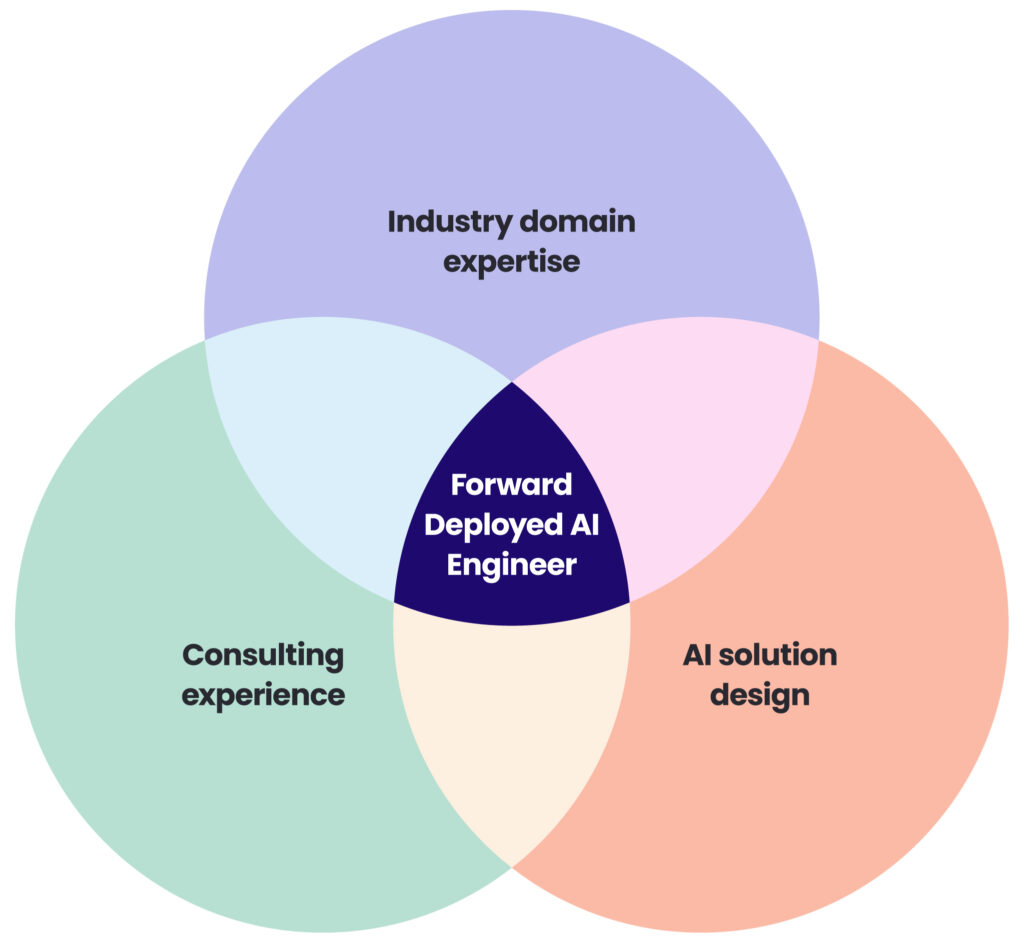
This isn’t a business analyst who takes notes and hands them off to a development team. A Forward Deployed AI Engineer brings three distinct capabilities together in a single role:
- Industry domain expertise: they understand your sector, its operational logic, its regulatory environment, and its real constraints.
- Consulting experience: they can identify inefficiencies and opportunity gaps you may not have articulated yet.
- AI-supported solution building: they actively co-design and orchestrate AI-driven delivery.
The result is something quite different from traditional requirements gathering – FDEs bridge the gap between technical and business teams, acting as solution architects who ensure alignment before a single line of code is written. It’s closer to solution advisory: a process where the expert helps you shape the right problem before ever discussing the solution.
This distinction matters more than it might seem. Organisations often arrive with a problem statement that is really a symptom. The value of a truly Forward Deployed Engineer is their ability to reframe the question before any resources are committed to answering the wrong one.
From months to weeks: the delivery model behind the role
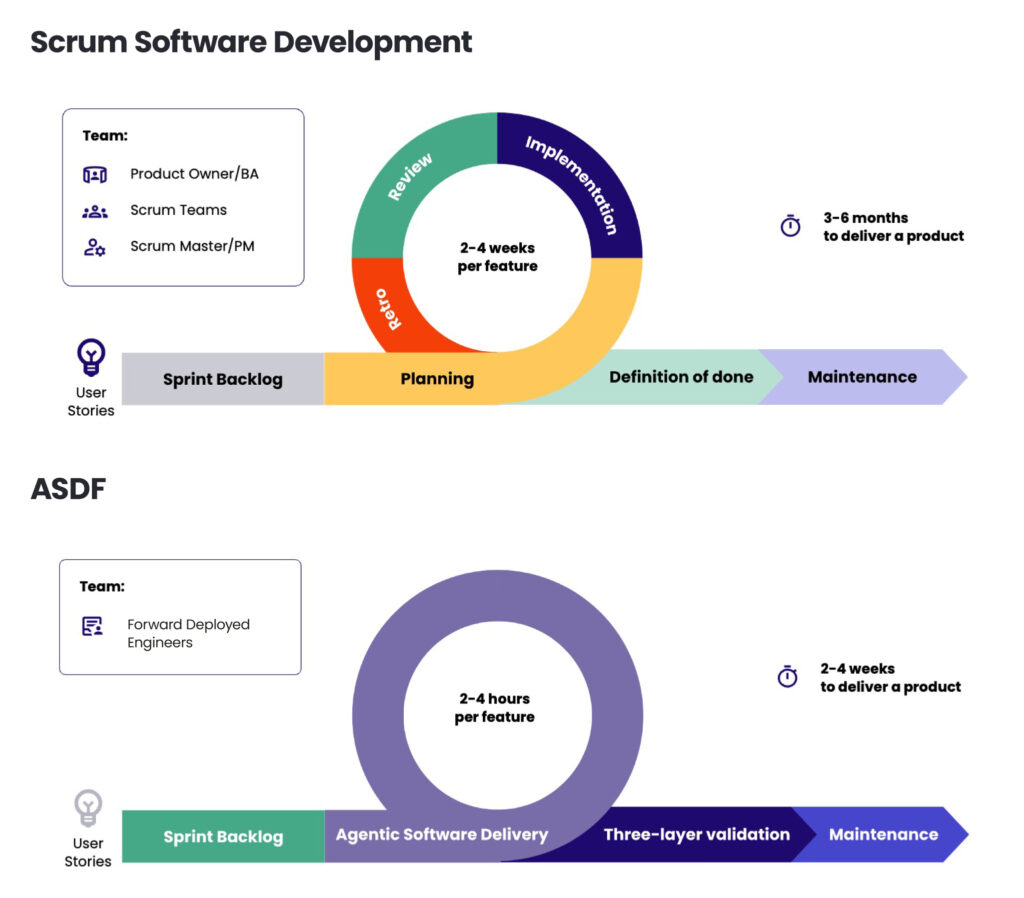
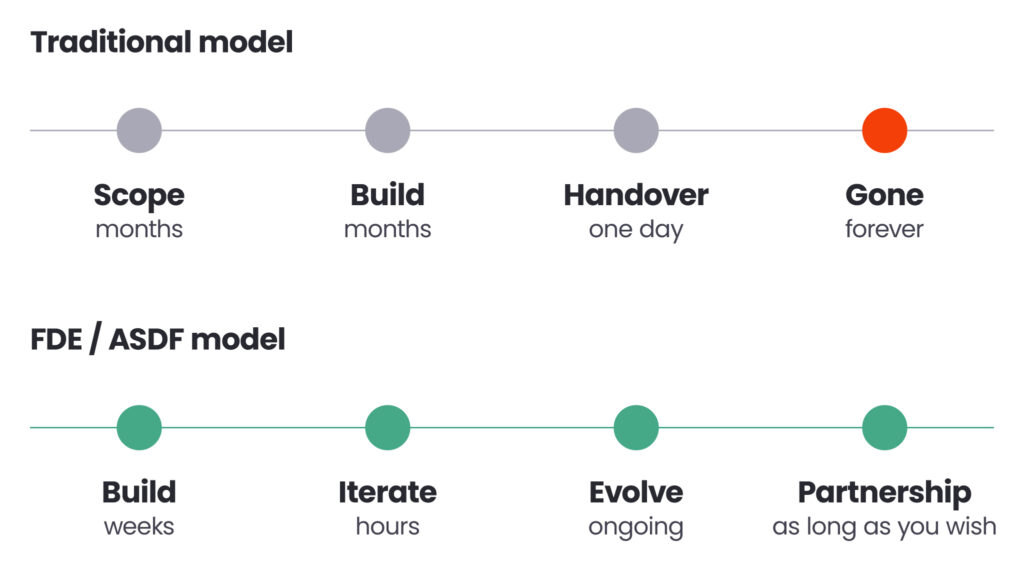
The role only makes sense alongside the delivery model it enables. Under a traditional Scrum approach, each feature takes two to four weeks to build. A full product takes three to six months. The cost is high, the timeline is long, and the risk falls disproportionately on the client.
The Agentic Software Delivery Framework inverts this. With the FDE acting as the primary consultant and AI agents handling orchestrated implementation, individual features can be built in two to four hours. Full products reach the market in two to four weeks. The upfront cost drops significantly – in many cases to a small initial fee against a flat multi-year contract. FDEs deliver early versions of solutions quickly, often launching a working prototype in 2–6 weeks, allowing value to become visible in days or weeks rather than months.
The four stages of delivery
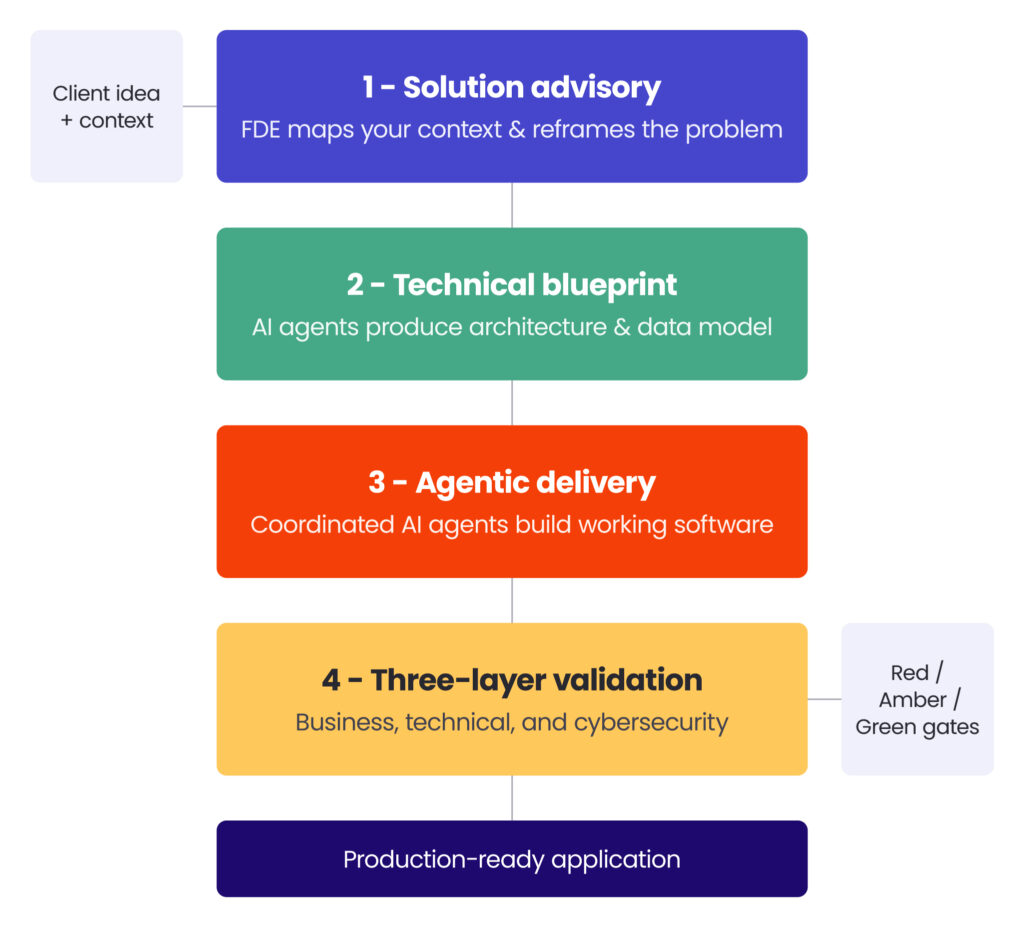
The process works in four stages:
1. Client idea → Solution advisory
The FDE works directly with you to understand the business context, map the current process, identify where it breaks down, and propose digital solutions. This is the phase where domain expertise is most critical – and where generic consultancies most often fail.
2. Requirements → Technical blueprint
Instead of a manual requirements document, orchestrated AI agents analyse the project definition, identify gaps, ask clarifying questions, and produce a structured technical specification covering application modules, system architecture, data model, integrations, and user roles. What used to take weeks of back-and-forth now takes days.
3. Agentic software delivery
A coordinated system of AI agents handles the implementation phase, each with a specific responsibility: implementation planning, plan validation, and coding. The FDE supervises and steers. The output is a working software, not just a demonstration, ensuring the solution is functional and operational within your environment.
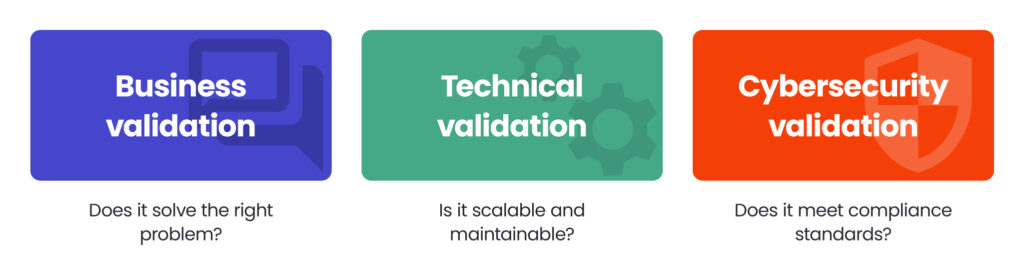
4. Three-layer validation
Before anything reaches production, the application passes through three human-led validation gates – business, technical, and cybersecurity – assessed on a Red/Amber/Green scale. Red issues must be fixed before deployment. Amber issues are deployable with accepted and documented risk. Green means production-ready.
Human oversight, built-in by design
One of the core design decisions behind ASDF is that human oversight is built into every stage of delivery. Here’s why that matters in practice.
AI accelerates implementation, but it doesn’t replace judgement. The value of the Forward Deployed AI Engineer is precisely that the speed of AI delivery only pays off when you’re building the right thing – and working that out requires human expertise that AI can’t currently replicate.
The three-layer validation model reflects this directly. Business validation checks that what was built matches what was actually needed. Technical validation ensures code quality, architecture, and technical debt are sustainable. Cybersecurity validation confirms the application meets current vulnerability and risk standards – including compliance with the EU AI Act, which now applies to many AI-assisted software deployments.
If you’re evaluating any AI-assisted consultancy, this is the risk management framework you should ask them to explain. Fast delivery without structured validation is just fast failure.
What makes this harder than it looks – and why it matters to you
The FDE model works, but it’s worth being honest about why it’s not the easy option.
The demands of the role are real
Running at this pace – delivering working software in weeks, iterating in hours – puts real pressure on the engineer. Your FDE is simultaneously managing your business context, steering AI agents, validating output, and translating technical decisions into language your stakeholders can act on. That’s a demanding role, and not everyone who calls themselves a forward deployed engineer can actually do it.
What this means when you’re choosing a partner
What this means for you in practice: the quality of the FDE you work with determines the quality of the outcome. This isn’t like hiring a development team where the process compensates for individual variation. The FDE’s ability to understand your business, ask the right questions early, and make sound architectural decisions shapes everything that follows. Ask hard questions about their sector experience before you commit.
It also means the first few weeks of engagement matter disproportionately. The requirements-to-blueprint phase, where your FDE works with AI agents to define the technical specification, sets the trajectory for the whole project. Rushing this phase to get to implementation faster is the most common mistake – and the hardest to fix once the build is underway.
Why the constraints can be treated as an advantage
The good news is that these constraints are features, not bugs. Because the model is built around a small, focused team rather than a large distributed one, decisions move faster, communication is cleaner, and accountability is clear.
And as your application evolves (new features, new integrations, changing requirements) the FDE model scales in a way that traditional project delivery doesn’t. Rather than re-scoping a contract or spinning up a new team, you iterate within an ongoing platform relationship. The engineer who understands your business on day one is still the one making decisions on day three hundred.
The strategic shift around AI solutions
There’s a bigger picture here that goes beyond any single engagement.
The traditional consulting and software delivery model organises itself around discrete projects: scope, budget, timeline, handover. The ASDF is organised around something different – continuous digital platforms and services. The shift is from one-off project delivery to ongoing, evolving partnerships.
Practical takeaways
If you’re evaluating whether this model is relevant to your organisation, here are the questions that matter most.
Before you engage any AI-assisted consulting partner:
- Ask them to distinguish between AI-assisted delivery and agentic delivery – if they can’t, they’re probably doing the former and calling it the latter.
- Ask specifically how validation works and who is accountable at each stage.
- Ask for a clear breakdown of what the FDE role covers versus what AI agents handle.
- Ask how the pricing model reflects the multi-year relationship, not just the initial build.
Red flags to watch for:
- No structured validation process beyond automated testing.
- FDEs who function as requirement gatherers rather than solution advisors.
- No clear answer on post-deployment responsibility.
- Timeline claims without a corresponding process explanation.
Green flags that signal genuine capability:
- Domain expertise that’s specific to your sector, not generic.
- A validation model with named accountabilities (business, technical, security).
- Transparent token- or usage-based pricing that scales predictably.
- Evidence of ongoing platform relationships, not just completed projects.

Conclusion
Forward Deployed AI Engineers aren’t rebranded business analysts with a ChatGPT subscription. We see them as a fundamentally different kind of practitioners, enabled by a different delivery model.
For organisations that have historically been priced out of custom software – and for decision-makers who have watched development budgets grow while timelines stretched – this model offers something genuinely new: fast delivery, structured oversight, and a long-term partner who stays accountable after the launch.
This article draws on the Agentic Software Delivery Framework developed by Spyrosoft. To learn more or discuss how it could apply to your organisation, contact us via the form below.
FAQ: Forward Deployed AI Engineers
Forward deployed engineers operate much closer to the business context. While traditional software engineers focus on building predefined requirements, FDEs help define the problem itself, shape the solution, and oversee delivery. They bridge the gap between technical systems and business needs, rather than working in isolation within a development team.
Agentic software delivery refers to a model where AI agents handle large parts of the software development process (such as planning, validation, and coding) under human supervision. This allows software development to move significantly faster while maintaining quality through structured validation and oversight.
With the right setup, individual features can be developed in hours, and full enterprise software solutions can be delivered in a matter of weeks. However, speed depends on proper problem definition, clear validation processes, and the expertise of the person guiding the process.
No. AI systems augment software engineers rather than replace them. Human expertise remains critical for decision-making, architecture design, and ensuring that AI-generated outputs align with business goals. The role of engineers is evolving toward higher-level problem solving and orchestration.
The main risks include building the wrong solution quickly, lack of proper validation, and over-reliance on automation without human oversight. That’s why structured validation (business, technical, and security) is essential in any AI-driven delivery model.
Quality is ensured through a multi-layer validation process involving human experts. This typically includes business validation (does it solve the right problem?), technical validation (is it scalable and maintainable?), and cybersecurity validation (does it meet compliance and risk standards?).
Unlike traditional project-based professional services, this model is built around ongoing partnerships. The same team (often led by the FDE) continues to support, improve, and scale the solution – or turns its attention to the next opportunity, identifying new workflows and processes within your organisation that are ready for AI-driven optimisation.
Yes. While especially valuable in professional services, FDEs can also support product companies by accelerating internal tool development, prototyping new features, and improving existing technical systems using AI solutions.




arrow_circle_rightContact us
Let’s find out if forward deployed engineering is a right fit for you

Tomasz Smolarczyk
Director of Artificial Intelligence
arrow_circle_right Our articles