Ready-to-deploy automotive IVI and cluster
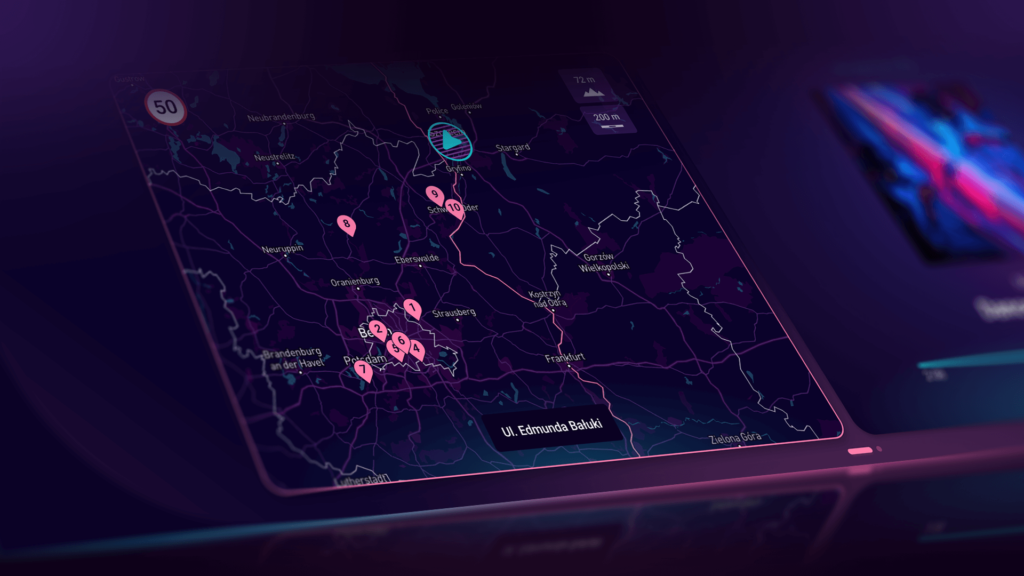
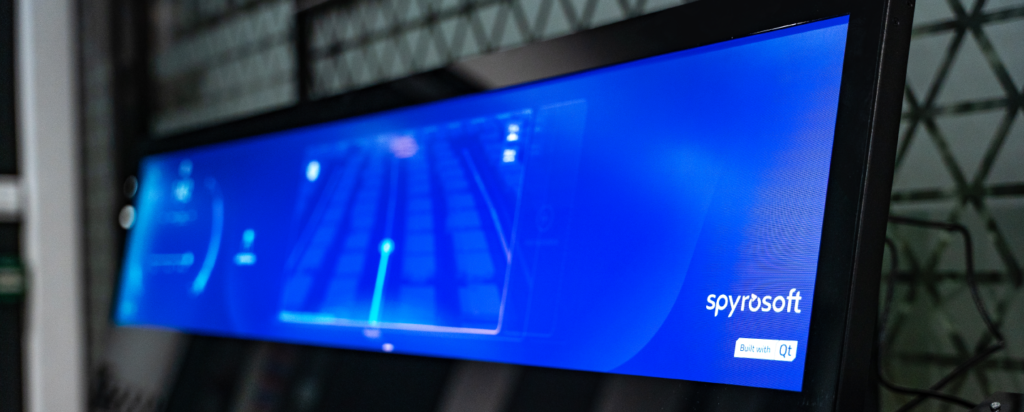
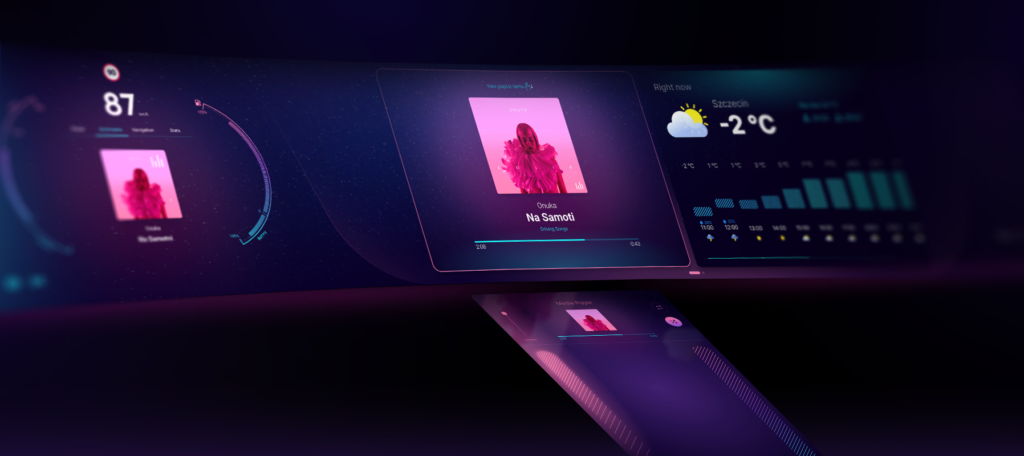
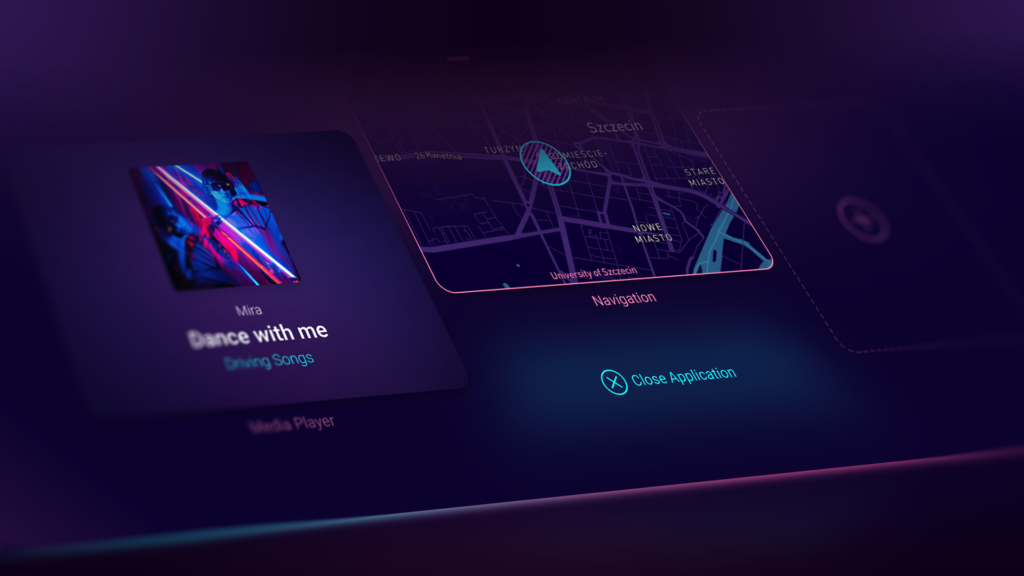
Design functional, sleek, and brandable in-vehicle infotainment systems using our new HMI platform. It combines the Wavey IVI cockpit with an integrated, automated Squish testing environment, built on a Qt-based microHMI architecture.
arrow_circle_right Competencies and partnerships
Proven and trusted by








Key features
Multimodal interaction
Combine gesture, touch and voice for distraction-aware control. AI models interpret intent in real conditions, reducing the need for precise gestures or phrasing.
AI-powered adaptivity
Integrate lightweight on-device or cloud LLMs for natural-language commands. Let drivers speak naturally to control navigation, media or climate.
Accelerated development
A modular microHMI in Qt/QML supports rapid prototyping and parallel work on independent UI modules, shortening time to market.
High quality and reliability
Every code change triggers automated Squish tests in Docker. Unit, smoke and regression suites keep stability high across releases.
Customisable, brandable UI
With Qt QML you can tailor colour, layout and widgets without sacrificing performance.
Future-proof compliance
Built on Android Automotive OS with third-party app support and alignment to evolving automotive standards.
How does it work?
Deploy
Install the Wavey cockpit app and test suite on your AAOS-compatible IVI hardware. The package includes source code, configs and scripts.
Develop
Extend or customise modules in Qt/QML. Teams work in parallel on media, navigation, HVAC and more. Unity, Unreal or Kotlin can complement the toolset where helpful.
Automate
Each commit triggers GitLab pipelines. Squish unit, smoke and micro-app tests run in Docker. Failures are flagged with artefacts for quick fixes.
Regress
Nightly, the full suite runs, including hardware-in-the-loop on the automotive SoC, to validate integrated behaviour.
Release
Ship with confidence. You retain code ownership and can scale across programmes and trims.
What’s inside?
Multimodal HMI
Gesture, touch and voice for intuitive control. Context models reduce mis-triggers and improve hands-on-wheel time.
LLM integration
On-device or cloud LLMs (per OEM preference) enable conversational UX and context-aware actions.
Qt-based UI framework
A pure Qt/QML stack with microHMI architecture. Independent modules simplify expansion and customisation.
Automated testing
Squish-based CI/CD with Docker and GitLab validates each change. Nightly full regression ensures end-to-end integrity.
Hardware and OS support
Reference: Qualcomm SA8155P under Android Automotive OS. Compatible with broader AAOS hardware.
Documentation and training
Developer docs, test reports and optional Qt and Squish workshops from Spyrosoft experts.
Ideal use cases
OEM and Tier-1 cockpit programmes with gesture and voice.
Rapid prototyping of multimodal UX for showcases.
IVI systems integrating AI voice assistants.
QA environments for software-defined cockpits.
arrow_circle_right Testimonials
Clients say about us
Technology stack
Qt/QML
Industry-proven framework for HMI development. We use Qt (with C++/QML) for fluid, high-fidelity UI creation.
Android Automotive OS
The underlying operating system for Wavey, enabling seamless integration with vehicle functions and third-party automotive apps.
Qualcomm SA8155P SoC
Reference hardware platform supporting graphics, audio, camera and connectivity features.
Squish GUI Tester
Automated UI testing tool for Qt apps. Squish simulates user gestures and verifies UI behaviour end-to-end.
Unity / Unreal Engine
Optional for 3D visualization and AR overlays .
Docker Containers
All tests are containerised for consistency and portability across development and CI environments.
GitLab CI/CD
Pipeline automation triggers unit, smoke and regression tests on each commit, providing rapid feedback on code changes.
On-device and cloud-based AI / LLM
Services for natural language processing.




arrow_circle_right Our team
Meet our experts

Passionate about daily human and machine communication, I take care of the development of the HMI area and empower Spyrosoft teams to stay at the forefront of this dynamic field. With a strong background in both technical and managerial positions, I know how to translate business needs into an appealing and functional product that elevates the experience of an end customer.

I’m a firm believer in the cultural ramifications of user-focused design in technology.
Throughout my career, I have led teams in developing modern products on a multitude of software and hardware platforms. The knowledge of HMI architectures and C++/C#/Java and Python languages, has allowed me to work with OEMs and TIER1s on the next-gen production HMI platforms.
With my motivation of building tomorrow’s digital society, I’m is mainly responsible for shaping the technology definition and vision of HMI Services at Spyrosoft.

I use the experience I have gained in twenty years of work to design interfaces for HMI. I highly value simple solutions to complex problems.
In my work, the most important thing is to diagnose and understand the problem, listen to the stakeholders and propose a solution that meets the established criteria.
I especially appreciate the substantive support of programmers, thanks to which our projects move easily to the implementation stage, which allows us to quickly test our hypotheses.


arrow_circle_rightcontact us
Let’s talk about your next automotive IVI and cluster
Przemyslaw Krzywania
HMI Director
FAQ
A microHMI is a modular architecture where UI features are delivered as independent, lightweight components. It speeds parallel development and simplifies branding.
Squish simulates real user interactions across your Qt widgets and QML. It validates behaviour end to end and integrates with CI to gate merges on test results.
Yes. We support efficient on-device models for low latency and privacy, with a cloud fallback where connectivity and feature scope allow.
We align requirements, verification and safety cases with your process, using traceable artefacts and automated testing to maintain compliance.
The reference is Qualcomm SA8155P on AAOS. We can assess and port to other AAOS-capable platforms.