Automating IT operations for a seamless experience – ZeroOps


Modern IT environments were never intended to be this complex. Although cloud-native architectures, distributed systems, microservices and continuous delivery have enabled unparalleled speed and scalability, they have also increased operational overheads to unprecedented levels. Despite years of automation, teams still spend countless hours managing incidents, tuning infrastructure, handling security updates, and responding to alerts requiring immediate human attention.
DevOps has helped to break down the silos between development and operations teams, enabling faster delivery through shared responsibility. Platform Engineering and NoOps have built on this by abstracting infrastructure and providing developers with self-service platforms. However, even in these advanced models, the need for operations has not disappeared. It has merely become more organised and automated.
The latest development in IT operations is ZeroOps, short for ‘Zero Operations’. This concept describes an environment in which systems are designed to run themselves, requiring minimal human intervention for day-to-day operational tasks. Rather than engineers having to react to failures, scaling issues or security gaps, the platform can detect, decide and act autonomously. The focus shifts from ‘you build it, you run it’ to ‘it runs itself’.
In this article, we explore the meaning of ZeroOps, how it differs from DevOps and NoOps, and why it is best understood as a natural progression for organisations that have already invested in cloud-native architecture, platform engineering and intelligent automation, rather than a radical replacement.
The shift to self-managing IT
At the core of ZeroOps is a clear shift in responsibility: from engineers manually running systems to self-managing platforms. The guiding principle is that developers should dedicate 100% of their time to building and improving product functionality while the underlying infrastructure independently handles operations. This self-sufficiency is achieved through tightly integrated, intelligent capabilities.

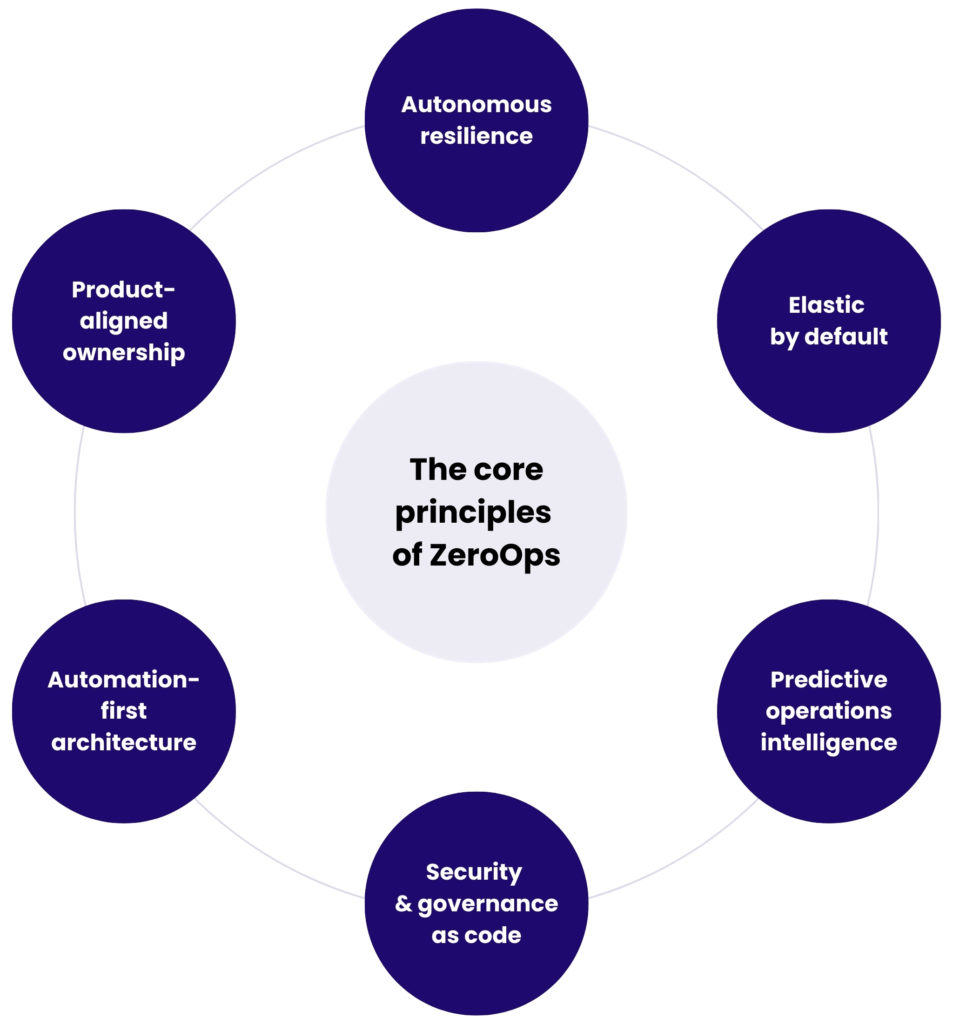
ZeroOps is defined by a set of architectural and operational principles that, when considered together, enable autonomous system behaviour. These guarantee that operational concerns are embedded in the platform itself, allowing systems to respond, adapt and optimise independently.
The 6 basic principles of ZeroOps
- Autonomous resilience
Systems must be able to detect, diagnose and recover from failures independently. ZeroOps platforms analyse metrics, logs, traces and events continuously in order to identify anomalies and perform automated root-cause analysis. They then execute remediation actions such as restarts, rollbacks, traffic rerouting and re-provisioning. The aim is to minimise mean time to recovery (MTTR), eliminate alert fatigue and ensure reliability through design rather than escalation.
- Elastic by default
Infrastructure must adapt to real-time demand on an ongoing basis. ZeroOps replaces manual capacity planning with demand-driven, fine-grained scaling based on performance, utilisation, and business metrics. This ensures predictable performance, cost efficiency and uninterrupted service, with resources scaling precisely when needed and contracting when demand falls – all without operator involvement.
- Predictive operations intelligence
Operations teams should anticipate issues before users experience them. ZeroOps systems use AIOps and advanced observability to identify patterns, forecast failures and detect early signs of degradation. Predictive models learn from historical incidents and system behaviour, enabling proactive or fully autonomous corrective actions. This shifts operations from reactive firefighting to continuous optimisation.
- Security & governance as code
Rather than being layered on top, protection and compliance are built into the system. ZeroOps enforces identity and access controls, network policies, and compliance rules via policy-as-code and continuous validation. It automatically detects and remediates misconfigurations and vulnerabilities, thereby reducing risk and eliminating the need for manual audits and security bottlenecks.
- Automation-first architecture
Anything that can be repeated should be automated and designed to scale. ZeroOps platforms are built on infrastructure as code, automated remediation, continuous monitoring, and self-service workflows. Automation is considered a fundamental architectural principle to ensure that the operational effort required does not increase in direct proportion to system complexity or scale.
- Product-aligned ownership
Teams are responsible for outcomes, not just deployments. Operational responsibility is embedded within autonomous, product-aligned teams that are supported by ZeroOps platforms. This model accelerates decision-making and improves accountability, while eliminating the need for centralised operations. This enables teams to prioritise delivering value over operational overheads.
ZeroOps vs. DevOps vs. NoOps
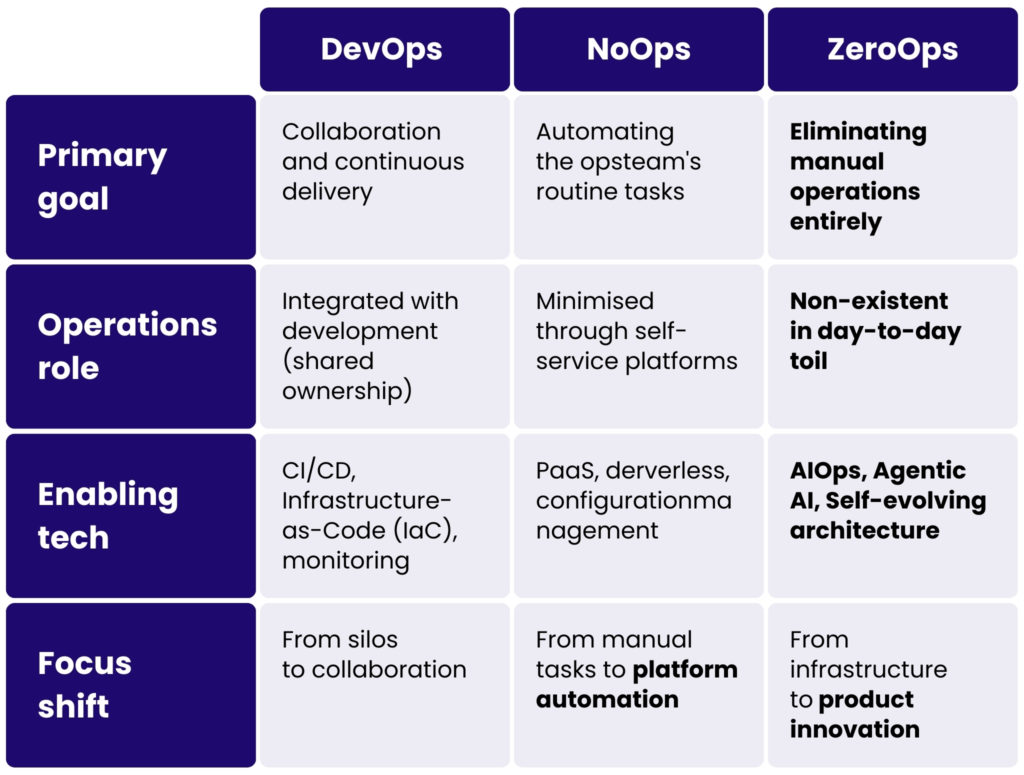
As digital systems have grown in scale and complexity, organisations have continuously redefined how software is built, deployed and operated. DevOps, NoOps and ZeroOps represent three distinct stages in the evolution of operational models, with each stage overcoming the limitations of the previous one.
Instead of being competing concepts, they represent a progressive shift in responsibility, automation and autonomy.
ZeroOps vs. DevOps vs. NoOps
As digital systems have grown in scale and complexity, organisations have continuously redefined how software is built, deployed and operated. DevOps, NoOps and ZeroOps represent three distinct stages in the evolution of operational models, with each stage overcoming the limitations of the previous one.
Instead of being competing concepts, they represent a progressive shift in responsibility, automation and autonomy.
DevOps – optimising collaboration & delivery
The focus is on improving collaboration between the development and operations teams to enable faster and more reliable delivery. While operations remain a shared responsibility, they are supported by CI/CD pipelines, infrastructure as code and monitoring. Although this model significantly improves speed and stability, continuous human involvement is still required for incident response, capacity management and optimisation.
To sum up – DevOps improves how humans operate systems, but humans remain central to operations.
NoOps – hiding operations behind platforms
It reduces visible operational effort by shifting responsibility to self-service platforms, such as PaaS and serverless environments. While developers interact with higher-level abstractions, operational complexity is centralised within the platform. While this reduces routine tasks, operations are not entirely removed, which can limit flexibility and visibility when systems behave outside of predefined patterns.
To sum up – NoOps minimises visible operations but does not eliminate operational work entirely.
ZeroOps – autonomous operations by design
It eliminates manual operations by design. Systems operate autonomously, using AIOps, agentic AI and self-evolving architectures to monitor, scale, secure and remediate themselves in real time. Human effort is shifted towards defining policies, automation and system behaviour, enabling teams to prioritise product innovation over infrastructure management.
To sum up – ZeroOps eliminates manual operations by embedding intelligence and autonomy into the system itself.
What does ZeroOps mean for developers and operations teams?
ZeroOps fundamentally changes the way teams interact with technology by eliminating operational friction and transferring responsibility to a higher level of abstraction.
For developers, ZeroOps enables a complete transition to product-centric work. The platform autonomously handles infrastructure provisioning, scaling, reliability, and security, allowing developers to focus on features, user experience, and business value. Operational concerns no longer interrupt delivery, thereby reducing cognitive load and improving speed, quality and developer experience.
For operations and SRE teams, ZeroOps shifts the focus from reactive incident handling to strategic platform ownership. Rather than responding to alerts or tuning infrastructure, these teams design and govern the automation, resilience patterns and security policies that enable systems to operate autonomously. Their expertise is applied at the architectural level, where it has a lasting impact.
Beyond roles, ZeroOps requires a cultural shift towards trusting automation, making data-driven decisions and using AI-powered systems. Human intervention becomes the exception, with intent-driven governance replacing manual control, an essential change for sustaining autonomy at scale.
Wrapping up
As system architectures become more distributed and dynamic, traditional models based on monitoring, manual intervention and reactive responses are no longer effective. The operational complexity of modern environments exceeds the rate at which human-driven processes can respond reliably.
ZeroOps addresses this challenge by embedding resilience, scalability, intelligence and governance directly into the platform. Systems are designed to operate autonomously, freeing up teams to focus on higher-value initiatives. Building on the foundations of DevOps and platform engineering, ZeroOps takes these approaches further with AI-driven decision-making and self-management capabilities.
For organisations that have already adopted cloud-native technologies and automation, ZeroOps is the next logical step, shifting the focus from operating infrastructure to designing systems that can operate independently.
Choose Spyrosoft as your partner for designing ZeroOps
ZeroOps is a capability that requires intentional design, construction and evolution. If you are looking to reduce operational overheads, improve reliability at scale or transition from reactive to proactive operations, now is the time to assess where autonomy could have the greatest impact! The journey to ZeroOps starts with a clear strategy, whether through platform modernisation, AIOps adoption, or automation-first architecture.
Contact our experts to find out how autonomous operations can accelerate your next phase of growth and what can be applied to your environment.
ZeroOps is an operational model in which systems are designed to manage themselves with minimal human intervention. Platforms can autonomously detect issues, scale resources, enforce security policies and remediate failures. The focus therefore shifts from manually running infrastructure to designing systems that can operate independently.
Although DevOps improves collaboration between the development and operations teams, it still relies on human-driven processes. NoOps hides much of the operational complexity behind platforms; however, operations still exist in the background. ZeroOps takes this a step further by embedding AI-driven intelligence and automation directly into the architecture, thereby eliminating the need for day-to-day manual operational tasks.
ZeroOps eliminates operational drudgery, not expertise. Operations and SRE teams shift their focus from reactive incident handling to designing automation, resilience mechanisms, and governance policies. As a result, their role becomes more strategic, focusing on building and evolving autonomous platforms.
ZeroOps reduces operational overheads, minimises downtime, and improves scalability by providing autonomous resilience and predictive intelligence. It enables faster innovation by freeing developers from infrastructure concerns. Ultimately, it enhances reliability and cost efficiency, allowing teams to prioritise delivering product value over managing systems.


arrow_circle_rightcontact us
Focus on your core business, while we manage your IT infrastructure maintenance

Filip Rozanski
Head of Managed Services
arrow_circle_right our blog


