NVIDIA Alpamayo and the AI case for L4 autonomy: reasoning, safety, and what it takes to integrate it


Part 1 of this series covered what’s already in production: the Hyperion platform, NVIDIA’s L2++ architecture in the Mercedes-Benz CLA, and the committed L4 roadmap through to 2028.

This article covers the shift that made all of it possible. Three AI developments in the last 3-4 years delivered more progress in autonomous driving than the entire previous decade. Understanding them changes how you think about SOTIF scope, safety case obligations, and integration strategy for any programme that touches the NVIDIA DRIVE stack. We also cover what it actually looks like to run Alpamayo in practice.
The AI leap: what changed in the last three years
Marco Pavone, NVIDIA’s Director of Autonomous Vehicle Research and a Stanford professor, described the shift plainly: more progress in autonomous driving in the past 3-4 years than in the previous decade combined. These three developments drove that acceleration.
1. Foundation models brought world knowledge into vehicles
Previous AV systems only knew what their training data had shown them. Foundation models let a vehicle reason about situations it’s never seen before – a mattress in the road, a ball rolling into the street. Pavone’s analogy is useful: when you learn to drive at 18, you bring 18 years of world experience with you. Foundation models do the same for AV stacks.
2. End-to-end architectures eliminated the handoff problem
Traditional AV pipelines pass data across discrete modules (perception, prediction, planning, control) and lose context at every handoff. End-to-end architectures take raw sensor input and output a driving decision in a single pass, keeping full situational awareness throughout. It changes the failure mode profile entirely.
3. Reasoning, not just reacting
NVIDIA’s Alpamayo is a 10-billion-parameter Vision-Language-Action model trained across 25 countries and 2,500+ cities. It produces a trajectory plus a reasoning trace. A concrete example: “Nudge to the left to increase clearance from construction cones.“
Explainability is a prerequisite for regulatory approval of AI-based driving systems. The reasoning trace is what makes the approval path tractable, and its absence is exactly what makes pure black-box neural networks hard to certify. If you’re running SOTIF assessments on an AI-based ADAS stack, this matters directly.
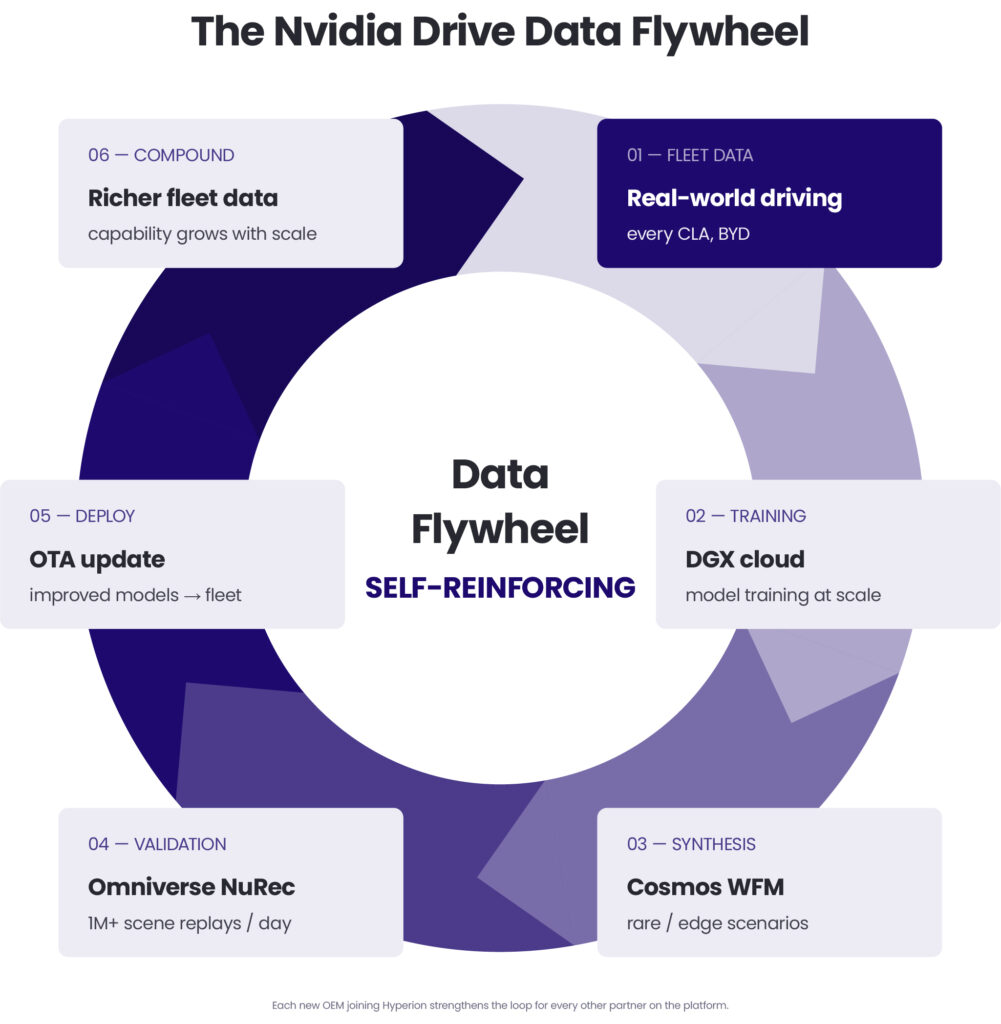
The data flywheel compounds all three
Every vehicle on the DRIVE platform feeds real-world driving data back to DGX cloud systems for model training. NVIDIA Cosmos generates synthetic variations of rare and dangerous scenarios at scale. Neural reconstruction (NuRec) runs more than one million validated scene replays per day. Better models return to vehicles via OTA update.
Each new OEM that joins Hyperion makes the loop stronger for everyone on the platform. The more programmes that run on Hyperion, the faster Alpamayo improves for all of them. A standalone stack can’t replicate that. It’s a structural advantage that compounds with adoption.
Safety: what ASIL D at the AI layer actually means
ISO 26262 was written for deterministic systems. Fault tree analysis and FMEA methods assume predictable, bounded behaviour. A 10-billion-parameter neural network isn’t predictable in that classical sense. This is the tension every OEM faces when integrating an AI-based driving stack, and picking a certified platform doesn’t resolve it.
NVIDIA’s answer is Halos, built on three principles:
- Diversity – classical and end-to-end stacks run in parallel, neither is a single point of failure and each continuously bounds the other
- Monitoring – the Halos OS runtime enforces a behavioural envelope around the neural network continuously – not just at validation time
- Validation – NuRec runs more than one million scene replays per day, so every software release gets validated against fleet-scale real-world data
The investment behind Halos is substantial: 15,000+ engineering years, 1,000+ AV safety patents, 240+ peer-reviewed safety papers, and an ANSI-accredited AI Systems Inspection Lab – the first programme that integrates functional safety, cybersecurity, and AI safety into a single accredited framework.
NVIDIA certifies the platform. Every OEM integrating Hyperion into a vehicle programme still owns its own safety obligations:
- HARA for your specific vehicle and ODD – NVIDIA’s platform HARA doesn’t cover the vehicle integration boundary
- ASIL decomposition for the system architecture at integration
- A Safety Case covering compliance with NVIDIA’s Assumptions of Use
- SOTIF analysis under ISO/PAS 21448 – ISO 26262 doesn’t fully address AI/ML behavioural insufficiency
- A-SPICE process compliance for all your development activities
This is the standard model for platform-based development. It mirrors how OEMs have always worked with AUTOSAR, QNX, or any certified supplier layer. The difference with AI stacks is that SOTIF scope grows substantially: every reasoning-based component you add creates new scope. Most OEM safety teams haven’t fully mapped that yet, and it tends not to become visible until you’re well into the integration.
We ran Alpamayo – here’s what we found
Most organisations reading about Alpamayo are still deciding whether to start. We already ran it.
We worked on an NVIDIA DGX Spark, which is an NVIDIA’s desktop AI supercomputer delivering 1 PFLOP of FP4 performance, shipping since October 2025. We ran the full Alpamayo 10B inference pipeline with real multi-sensor inputs and validated three concrete driving scenarios:
- Red light detection with decision trace generation – we verified that the reasoning output is machine-readable and audit-ready, not just a label for human consumption.
- Night-time lane change at intersections in low-visibility conditions – we tested model behaviour under poor sensor conditions, where camera-based perception is hardest to trust.
- Speed adaptation for curved roads – we evaluated trajectory quality and reasoning coherence under constrained geometry.
NVIDIA’s official distillation scripts for Alpamayo are scheduled for June 2026, with a closed-loop reinforcement learning framework alongside them. Fine-tuning tooling arrived in March 2026. Our implementation came before any of that public tooling, which gives us a concrete lead for any OEM or Tier 1 assessing integration readiness before NVIDIA’s official release.
One specific finding from that work: Alpamayo’s reasoning traces hold up for regulatory purposes, not just technical demonstration. That matters because SOTIF assessors will eventually require explainability infrastructure for AI-based systems. Knowing the audit trail works before the certification conversation starts is operationally valuable.
What we can do for your programme
As a result of that hands-on work, we offer:
- Readiness assessment of your existing AV stack for Alpamayo integration
- Integration strategy – architecture, deployment approach, data pipeline design
- Prototype acceleration ahead of NVIDIA’s June 2026 distillation tooling
- Explainability and audit logging for regulatory approval workflows
- Edge deployment architecture for the compute constraints of production vehicles
AI-driven development in the innovation driven sector
Find out how we can help you
Alpamayo integration compounds the safety challenge. Every reasoning-based AI component you add to a vehicle programme creates new SOTIF scope and puts new demands on the safety case. The combination of hands-on Alpamayo experience and full-stack functional safety capability in one partner is uncommon. For teams navigating the NVIDIA DRIVE ecosystem, that combination matters.
Ready to move from evaluation to integration?
Whether you’re assessing the NVIDIA DRIVE platform for the first time or you’re already mid-programme and facing SOTIF scope questions, the right conversation starts with the specifics of your stack.
We’re engineers who’ve run this code. If that’s useful to you, let’s talk. Contact us via the form below. Also, explore our Functional Safety services to see how we support OEMs and Tier 1s from HARA to Safety Case.


arrow_circle_rightContact us
Get in touch to discuss your needs

arrow_circle_right Our articles