Why Embassy is the smarter embedded platform for high-stakes products


Embedded systems teams often overpay for software platforms that deliver far more than their application actually needs – and far less flexibility than they require. Embassy, an in-house embedded software system developed by Spyrosoft, offers a different approach: a lean and modular foundation that runs from prototype to production across automotive, agricultural, medical, and IoT applications. This article examines what makes Embassy architecturally distinct, when it makes economic sense to choose it, and more.
The platform trap that’s rarely talked about
You make most embedded software decisions once, and then live with them for a decade. A team selects a platform under time pressure, often defaulting to a well-known name or a solution the lead engineer has used before. The initial licensing deal looks manageable. Then, twelve months into the project, the real costs start to surface: mandatory subscriptions, complex configuration workflows, hardware-specific BSP dependencies, and a growing gap between what the platform offers and what the product actually needs.
This is the embedded platform trap. The real issue is a flawed evaluation framework – one that focuses on feature lists rather than total cost, vendor independence, and architectural control.
Embassy, developed by Spyrosoft as proprietary intellectual property, was built specifically to avoid this trap. It is a field-tested embedded software system with over four million units deployed in production, spanning automotive controllers, battery management systems, and various other use cases.
What it actually costs to run a legacy embedded platform
Most embedded platform evaluations focus on the upfront license cost. For traditional stacks in the AUTOSAR Classic category, that number tells only part of the story – integration, tooling dependencies, and long-term maintenance can push the real number well above the initial figure.
Initial costs for conventional vendor platforms (license, bring-up, integration) are typically several times higher than Embassy’s equivalent. Annual maintenance adds further license fees on top of internal engineering effort. We designed Embassy’s licensing as straightforward and predictable, with no recurring license fees and no mandatory tooling ecosystem.
The indirect costs matter just as much:
- Vendor-tied toolchains require specialised training. Engineers who leave take that knowledge with them.
- Platform updates driven by vendor or community roadmaps can force breaking changes at inconvenient moments.
- Hardware porting requires OS-level updates and BSP integration work that scales poorly across MCU families.
What Embassy is, and how it is built
Embassy is an embedded basic software system written in C, designed to provide essential system services for microcontroller-based devices. The architecture is modular: teams use only the components they need, without carrying the overhead of unused functionality.
Key technical facts
The system is:
- Written in C with a toolchain-agnostic build system,
- Free of third-party licenses (no ecosystem lock-in by design),
- ASIL and SIL compliant, supporting safety-critical applications,
- AUTOSAR-compatible, implementing conformance classes ICC2 and ICC3,
- Shipped with a bootloader ready for customisation.
The architecture covers all industrially relevant areas: operating system and communication services, runtime environment, memory and system services, safety and security modules, and the MCAL layer (drivers provided by microcontroller vendors). This last point is important – Embassy does not try to replace vendor HALs. It integrates with them cleanly, which keeps the porting surface small.
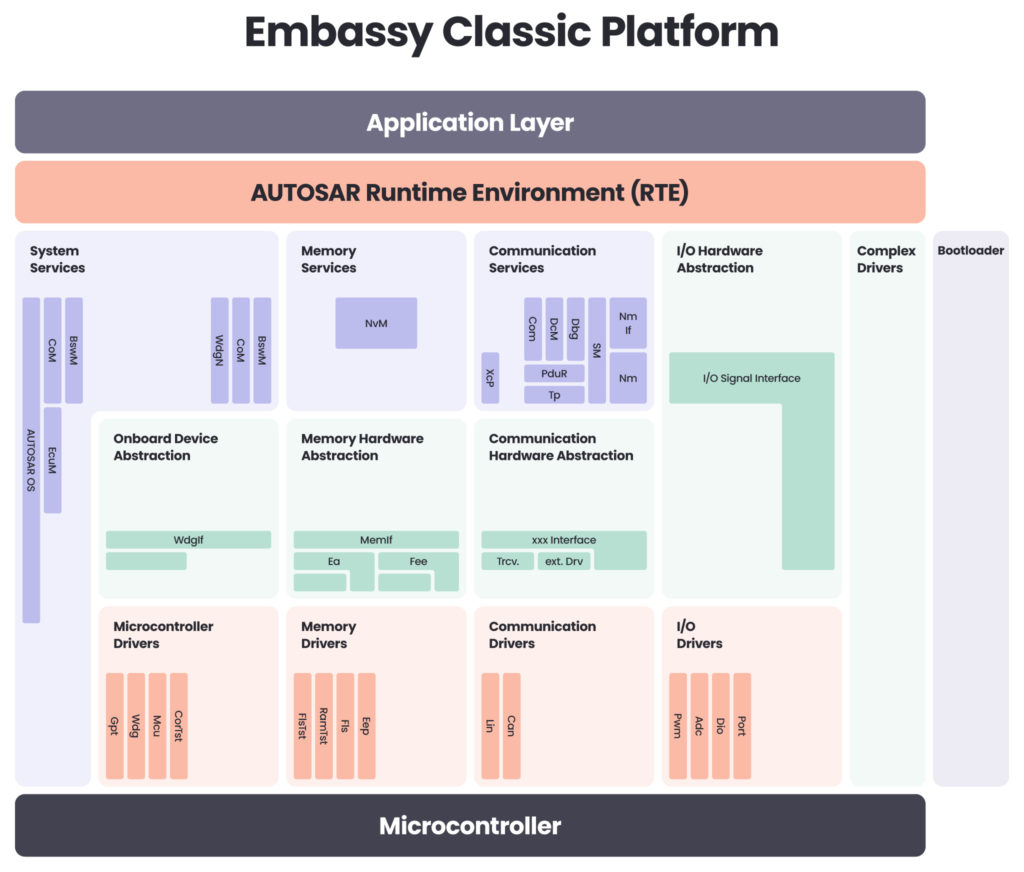
Development teams can work in the approach they already use: model-based development, CODESYS, or traditional C module development are all supported. This means your teams spend less time adapting to the platform and more time building the product, which is where you actually win or lose the time-to-market.
Embassy: position in the embedded landscape
While platforms like Zephyr or medical RTOS focus on connectivity and ecosystem integration, Embassy focuses on delivering a stable and lightweight system foundation for products where reliability and lifecycle control are key. The table below summarises the key differences.
| Aspect | Typical OS platforms (Zephyr/RTOS) | Embassy |
| Vendor & ecosystem dependency | Often tied to specific ecosystems, tooling, or vendor roadmaps | Vendor-independent, license-free, no ecosystem lock-in |
| Adapting to new hardware | Requires OS ports, BSP updates, and platform-specific layers | Lightweight architecture enables fast and predictable HW adaptation |
| Long-term flexibility | Evolution influenced by vendor or community direction | Full control over evolution and long-term product strategy |
The hardware-agnostic advantage
One of the most commercially important properties of Embassy is how quickly it can you can adapt it to new hardware. Typical porting time to a new MCU platform is eight to twelve weeks, depending on vendor HAL quality and BSP availability. That timeline is achievable because Embassy isolates essential system services from hardware-specific layers, keeping the adaptation surface predictable and bounded.
AI-driven development in the innovation driven sector
Find out how we can help you
The production track record spans a wide range of platforms:
- Infineon Aurix TC2xx – deployed in a car start/stop system with over four million units produced, and in a 48V battery management system,
- TI ARM (TTControl TTC 580) – used across 150 prototyping projects for fast product development and validation,
- ARM-based NXP and STM32 – deployed in e-motor controllers, vehicle controllers, BMS, and consumer electronics,
- Renesas RH850 – motor controller for three-wheelers up to 8 kW,
- ESP32 – lightning systems for yachts,
- Arduino – prototyping projects.
For teams managing multi-platform product portfolios (a common situation in automotive tier-two and industrial electronics) the ability to maintain a single software foundation across MCU families significantly reduces engineering fragmentation.
For product teams working to tight launch windows, that porting timeline is a competitive advantage. A platform that adapts to new hardware in eight weeks rather than six months keeps development cycles intact and reduces the risk of launch delays driven by integration work.
Embassy across industries
Embassy fits a specific, commercially important segment of embedded applications: those where reliability, lean architecture, and long-term maintainability matter more than rich connectivity stacks or complex middleware ecosystems.
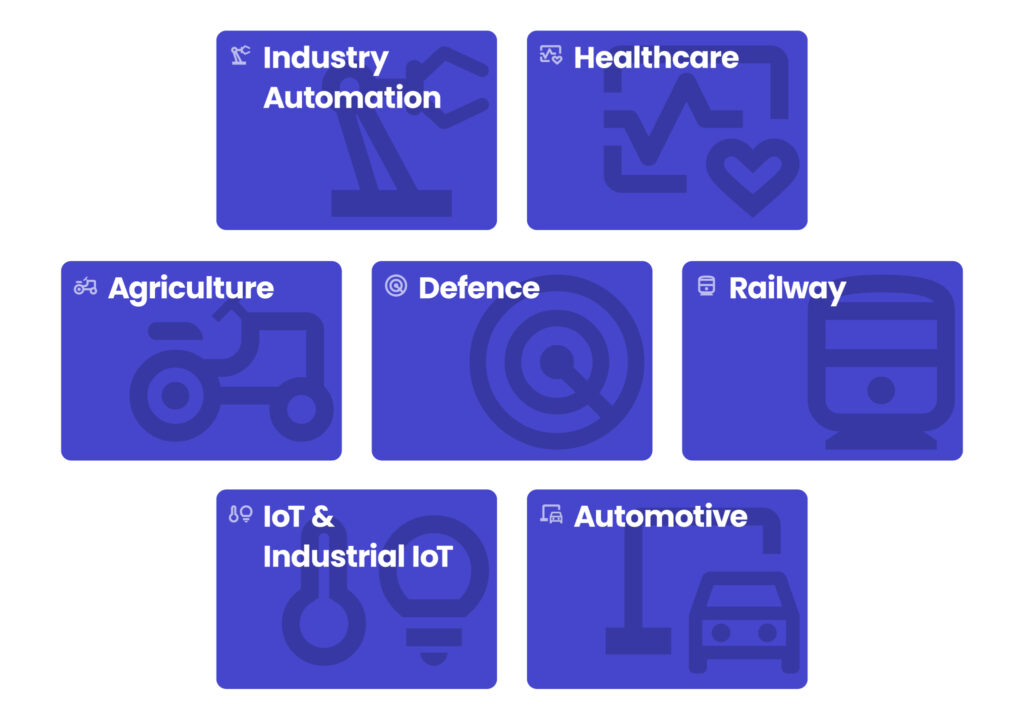
Automotive (light-to-medium complexity ECUs)
The clearest application space is automotive body and chassis electronics: seat controllers, mirror controllers, fuel flap actuators, lighting systems. These are applications where AUTOSAR Classic implementations are technically over-specified. Embassy delivers the relevant functional safety compliance (ASIL support) and automotive-grade reliability without the associated platform complexity and cost.
It is also well proven in battery management systems and motor controllers – applications with real-time performance requirements and long service life expectations.
Agriculture
Agricultural machinery ECUs (for seeders, harvesters, hydraulic controllers) require real-time performance, long service life, and the ability to operate in harsh environments. Embassy’s architecture supports control units and measurement systems – including applications that require sensor data aggregation and communication hubs.
Industry automation
Industrial applications require the same high-integrity embedded foundation as automotive, with equally long product lifecycles. Embassy’s industrial-grade foundation makes it a natural fit for machine control units, safety-related modules, and industrial IoT gateway devices aggregating sensor data via CAN. Its license-free architecture and toolchain independence make it a practical choice for industrial OEMs managing multi-generation product lines.
Micromobility and two/three-wheelers
E-bikes, scooters, and light electric vehicles represent a high-growth segment where embedded cost and time-to-market are genuine competitive variables. Embassy’s CAN/LIN support and scalable licensing model align well with the economics of this category.
Railway
Railway applications demand long service life, strict safety certification, and predictable maintenance cost – all areas where Embassy’s architecture is a natural fit. Its SIL compliance and hardware-agnostic design support the extended lifecycles and diverse hardware platforms common in rail infrastructure projects.
Healthcare and Industrial IoT
For monitoring and diagnostic equipment, and for IoT gateway devices aggregating data via CAN, Embassy provides the stable, high-integrity foundation these applications require. The absence of third-party license dependencies is particularly relevant here, as it simplifies regulatory documentation and long-term software supply chain management.
Hardware-backed protection – HSM
Cybersecurity is increasingly a platform selection criterion, not just a feature to add later. The EU Cyber Resilience Act is establishing mandatory requirements for products placed on the European market, and OEM security requirements in automotive are tightening.
Embassy’s approach to hardware-backed security is pragmatic. Rather than embedding a specific HSM implementation, it supports multiple integration paths: commercial HSM solutions, MCU vendor security features, and secure bootloaders with pre-integrated HSM. Security is isolated in the boot stage where possible, with runtime cryptographic services available when required.
This architecture preserves the platform’s hardware-agnostic properties. A project can adapt its security implementation as MCU vendor capabilities evolve, without rearchitecting the application layer.
Embassy licensing options
Embassy follows a simple and predictable cost model. Four licensing options are available:
| License type | Details |
| Lifetime license | One-time license for the lifetime of your project or product |
| Microcontroller-targeted license | Hardware-specific license for a selected MCU family or platform |
| Price-per-unit | Scalable model aligned with production volume (up to 1,000 units) |
| Maintenance packages | Updates, technical assistance, issue resolution – priced individually |
The Lifetime license suits teams that want fully predictable costs with no recurring royalties. The Microcontroller-targeted license works best when a product commits to a specific MCU family. Price-per-unit aligns cost with production volume, making it appropriate for projects where initial volumes are uncertain.
Conclusion
The embedded systems market is moving in two directions simultaneously. At the high end, software-defined vehicles and complex IoT platforms are driving demand for richer middleware and cloud connectivity. At the same time, the vast majority of embedded applications (body controllers, motor drivers, sensor hubs, agricultural ECUs, medical monitors) do not need that complexity. They need reliability, predictable costs, and faster time-to-market – not a six-month platform integration project before development can begin.
We created Embassy for that second category. It brings automotive-grade engineering discipline to applications where conventional AUTOSAR implementations over-specify the solution and where generic RTOS platforms lack the safety and regulatory structure the application requires.
To discuss whether Embassy fits your project or to explore licensing options, contact us via the form below.




arrow_circle_rightContact us
Talk to our experts and evaluate Embassy for your project

arrow_circle_right Our articles