Full-coverage AI evaluation: why judging everything beats sampling a share


Full-coverage AI evaluation can help businesses move beyond sampling and assess every item against consistent criteria, without relying entirely on manual reviews. From translation quality in Chemicals and customer interactions in Automotive to data classification in Geospatial, the approach can be applied across industries. In this article, we cover how to balance automated evaluation with human oversight and what does it take to make the process reliable.
Full-coverage AI evaluation changes the cost of quality control
Say you own a review queue and answer to finance for its cost. You sample it. Your team listens to a slice of the calls, reads a slice of the claims, checks a slice of the documents, and signs off on the rest by inference. You’re paying for the part you check and carrying the risk of everything you don’t.
Review a share, accept the blind spot.
That trade was the only affordable option as long as human review was the only review there was.
It isn’t any more. When scoring an item is cheaper than reviewing it by hand, the control point moves. You stop extrapolating from a sample and judge every item against a rubric. That’s full-coverage AI evaluation, or judge-everything-sample-nothing. It changes where the control sits, not how fast the old one runs.
This is a spend-and-risk decision before it’s a technology one. The share of the queue that stays with a human isn’t an accuracy gap the tool leaves behind. It’s a decision you make.
The mechanism: LLM-as-a-judge at full coverage, not a sample
An LLM-as-a-judge scores every item against a written rubric, the same one a human reviewer would use, and returns a score, a reason, and a flag for whatever needs a person. It doesn’t sample. It reads the whole queue. That’s the move: coverage goes from a slice to all of it, and the cost per unit reviewed drops far enough that scoring everything is the affordable option, not the luxury one.
Two delivered engagements, in two different industries, illustrate this point clearly. Both of them were carried out by Spyrosoft.
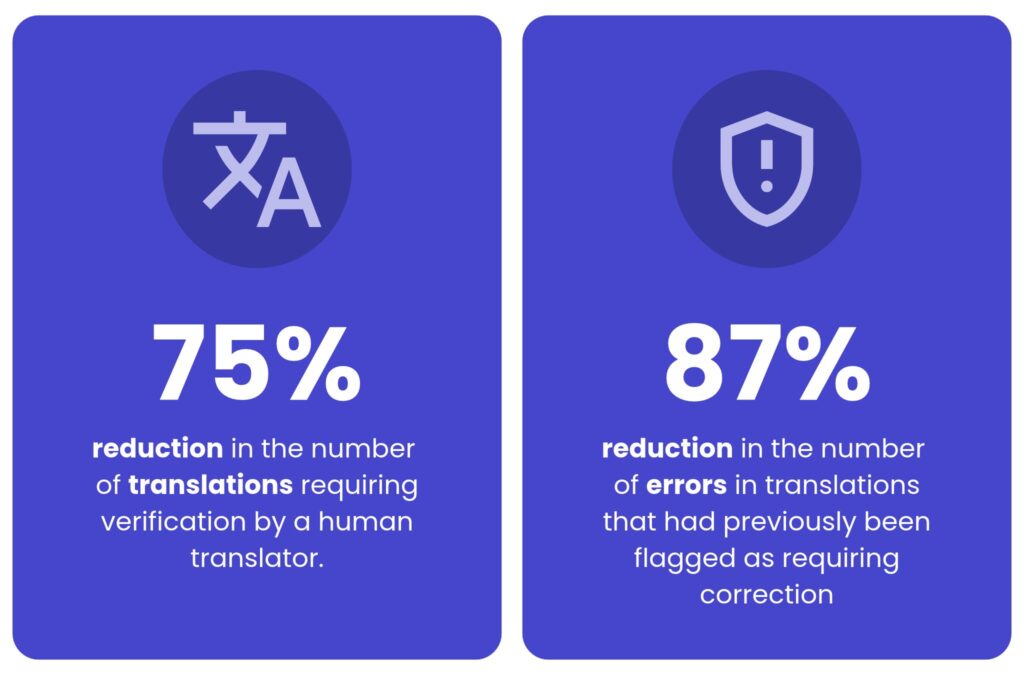
In the first one, Spyrosoft built an AI evaluation judge for a Fortune 500 chemical company and scored its translations against a rubric for correctness and cultural fit. It reduced the volume of translations requiring human review by 75% and decreased errors in previously flagged translations by 87%, across 14 language pairs. That’s full machine coverage, with the remaining quarter of that review volume still going to people.
In the second, it built an AI judge for a leading automotive parts retailer’s call centre and scored calls against the sales scenario instead of sampling a few: 100,000+ calls evaluated. Both examples are production systems, not demos.
An AI evaluation judge shows you the error rate in what it scored. Fixing the detected issues and errors remains a human task.
Reversibility, not accuracy, determines what stays for human review in AI evaluation
Full-coverage AI evaluation changes how much of a queue a human still has to touch; however, it doesn’t decide which items those are. That’s your call, and the thing that should drive it is reversibility: can a mistake here be caught and undone cheaply, or not.
Read the residual human share that way, and it stops looking like an accuracy ceiling and starts working like a controlling mechanism you set on purpose. It’s a human-in-the-loop control plane: the AI judge covers the whole queue, and the human steps in when reversing a mistake would entail high costs.
This leads to two modes. Where the judge sits before an output goes out – a translation, a draft, an agent’s action – reversibility sets what a human signs off before it lands. Where it scores after the fact, on calls already handled, it sets which items get a human follow-up.
An item that’s cheap to undo can run under the AI judge with a light touch. A miss is recoverable:
- a flagged document that is simply re-queued,
- a draft a later step will check anyway,
- an internal classification that costs little to correct.
An item that’s hard or impossible to undo requires human intervention regardless of the score, whether as a sign-off before it goes out or a follow-up on what already did:
- an irreversible customer-facing decision,
- a payment, or a message that cannot be recalled once sent,
- a call that surfaced something needing action.
The AI judge reads all of them at full coverage. Reversibility determines the kind of human attention each one gets, and how much.
This is also what stops full-coverage AI evaluation from overreaching. Setting the share by reversibility is what keeps it from sliding into a replace-your-reviewers argument, which it is not and should not be presented as. Reviewers move to the items where their judgement carries real risk, and skip the ones the rubric can hold.
The EU AI Act guardrail: what AI judge contact-centre QA may and may not score
Full-coverage scoring of a call centre touches recorded conversations, so the EU rule matters. In the EU, Article 5(1)(f) of the AI Act prohibits AI systems that infer the emotions of a person in the workplace from biometric data (face, voice, physiological signals), with an exception for medical or safety purposes; Article 3(39) is where the biometric basis comes from. A rubric that scores the content and process of a call, adherence to the sales scenario and its stages, sits outside the prohibition; inferring an agent’s emotional state from their voice sits inside it. Full-coverage call QA run as an LLM-as-a-judge on content and process is not what Article 5(1)(f) restricts.
Beyond the AI Act, we must consider a data-protection point: under the GDPR, the need for a lawful basis is EU-wide, while the national rules on recording calls and monitoring employees differ by country, and an outsourced call-centre contract may forbid access to the recordings altogether. Two things have to hold before any of these runs: a lawful basis to keep the recording and a rubric that stays on content and process.
Meta-evaluation: why the AI judge needs judging too
An AI evaluation judge you set up once and trust forever is a judge that drifts quietly out of calibration. Evaluations rot. The workflow shifts, the product changes, the model behind the judge gets updated, and the rubric that fit the work in January is scoring a different world by June. Judge drift concerns the judge itself. It drifts in the same way an unchecked human reviewer does, and for the same reason: nothing’s checking it. So the discipline that keeps judge-everything working isn’t a one-time setup; it’s a standing one. Meta-evaluation is checking the checker on a cadence, against a held-out reference set a human has labelled.
Here’s where the two engagements show their limits. Both judged human output, human translators and human agents on a script. That’s the tractable case. The moment the thing being judged is itself an AI agent, judge and judged can drift together, and the meta-evaluation is precisely what prevents agentic QA from fooling you.
Build it in as a control, in the same constrained-autonomy terms as the rest:
- A cadence: how often the checker is re-scored.
- A held reference: a set of items whose correct scores are fixed and human-owned, kept back from the judge.
- A trigger: a drift threshold that routes the judge back for recalibration before its scores are trusted again.
None of this is particularly unusual. It’s the feedback control any system that makes consequential decisions needs, pointed at the evaluator instead of only at the thing it evaluates.
Judge-everything without meta-evaluation isn’t full coverage. It’s a new blind spot wearing a dashboard.
Solving ‘we don’t have enough data yet’: Small-labelled-set classifiers at production accuracy
The objection that stalls most triage pilots isn’t about judging; it’s about data: we don’t have enough labelled examples to train anything yet. It’s a fair objection, but it’s usually wrong about how much data the first useful model really needs.
An LLM-as-a-judge approach needs no training data; it scores against a rubric. The data objection belongs to the other kind of queue, the one that needs a trained model: a classifier for triage, a detector for images.
A small labelled set classifier built with transfer learning starts with a model that already knows a lot and adapts it to your examples, so a useful first version takes far less labelling than training from scratch. That turns “not enough data yet” from a reason to wait into a question of which bounded problem to label first. Two of our delivered engagements can show the range.
Spyrosoft built a transfer-learning classifier for Ordnance Survey’s GetOutside app that sorted indoor from outdoor events and reached ~95% prediction accuracy from a small labelled set. The output showed which purchased data added nothing, resulting in savings of up to 65% on data purchases by eliminating useless vendors and datasets.
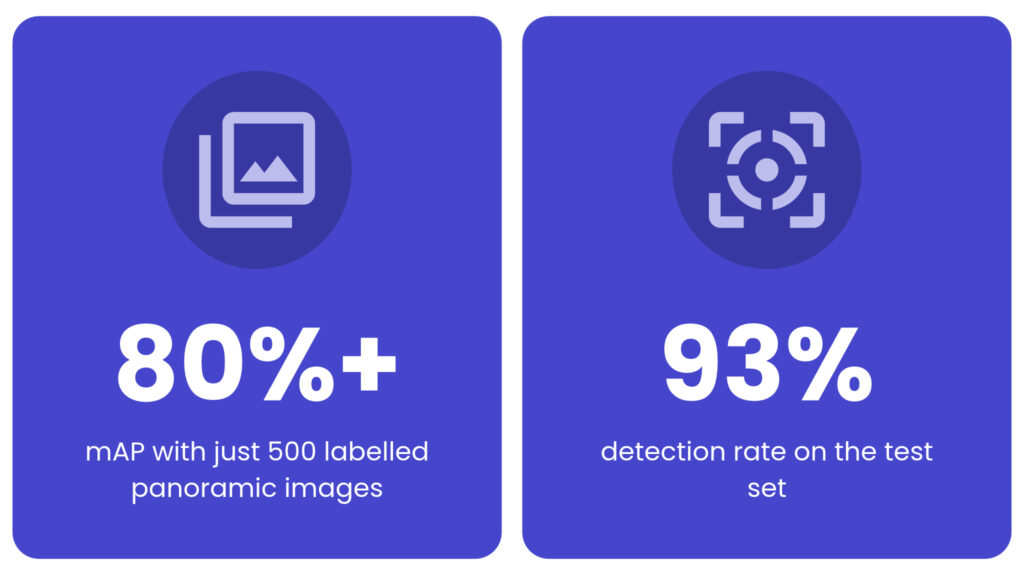
Another example is the road-sign detection pipeline created for NCTech, which reached 80%+ mAP with just 500 labelled panoramic images, and a 93% detection rate on the test set.
How far it carries depends on how separable the classes are and how well the problem is bounded. Where a mistake is hard to reverse, the human stays; the human share is where the open problems live. Road signs are the easy end, rigid and high-contrast with an objective ground truth to score against. The further a queue sits from that, the more judgement it takes and the bigger the human contribution.
Applying full-coverage AI evaluation mechanism to software delivery
The same mechanism runs in software delivery. An evaluation that judges every change against a rubric is the full-coverage move applied to code. We hold our own solutions to the same standard: AI goes into a process only when it shows a measurable gain and demonstrates that what it produces passes quality gates and a judge before it ships. That’s the controllable agentic delivery we bring to client projects.
The conversation worth having before you scale AI evaluation coverage
- Full coverage drops the cost per unit reviewed and extends coverage to the whole queue, judging every item against a rubric instead of a slice; what that means for the team depends on the process owner’s decision.
- Reversibility, not an accuracy ceiling, decides what stays with a human once the judge covers the whole queue.
- The checker needs checking, on a cadence, or full coverage becomes a new blind spot.
None of that is a rollout you size on day one. It’s a first queue you choose well. So if judge-everything-sample-nothing describes a queue you’re sampling now, the conversation worth having is which output type to put under full coverage first, and what in it stays human because a mistake there is hard to reverse. That’s a smaller and more honest question than how big the rollout should be, and it’s the one worth starting with.
If you’re searching for a partner to introduce full-coverage AI evaluation in your processes, contact us via the form below, and let’s explore how we can turn our experience into your gains.
FAQ
Yes, when scoring an interaction against a rubric is cheaper than reviewing it by hand. The judge scores the whole queue at full coverage instead of a sampled share. Spyrosoft has done it at scale, evaluating 100,000+ calls against a sales scenario for a leading automotive parts retailer instead of sampling a few.
As much as reversibility calls for, and no more by default. The residual human share is set by whether a mistake can be caught and undone cheaply: easily reversed items run under the AI judge with a light touch, while irreversible or high-stakes items require human sign-off before release, or human follow-up after the fact. It’s a deliberate control, not an accuracy gap the judge leaves behind.
Often, yes, with transfer learning from a model that already carries general knowledge. Spyrosoft Group built a classifier for Ordnance Survey’s GetOutside app that reached ~95% prediction accuracy from a small labelled set, and a detector for nctech’s road signs that reached 80%+ mAP with just 500 labelled panoramic images. The limit is scope: a classifier sorts items into a bounded set of classes, a detector finds objects in an image, and a two-class problem is easier than a wide taxonomy.
No. It changes the reviewer’s job; it doesn’t remove it. The judge covers the whole queue, and human reviewers move to the calls where judgement carries real risk. There’s a scope line in the EU too, since a rubric may score the content and process of a call, but Article 5(1)(f) of the AI Act prohibits inferring an agent’s emotions from biometric data in the workplace.


arrow_circle_rightContact us
Let’s discuss how we can help you with your tech projects


Tomasz Smolarczyk
Director of Artificial Intelligence
arrow_circle_right Our articles