From AI to ROI: AI agents for your business


Your organisation is facing a choice: continue adding narrow AI tools piecemeal or fundamentally rewire workflows around AI. McKinsey calls this the gen AI paradox: roughly 80% of companies report using generative AI, yet most see little to no impact on their bottom line. The culprit is that AI often remains bolted on: deployed in horizontal pilots or chatbots that generate diffuse benefits, instead of integrated into core processes. To turn AI from a novelty into value, you must embed AI deeply in business operations.
In practice, this means rethinking decisions, workflows, and human-AI collaboration, with intelligent AI agents serving as proactive catalysts, not just reactive tools.
This article will show you how you can implement AI effectively, with AI agents serving as practical enablers of measurable business outcomes.
The gen AI paradox: widespread adoption, limited impact
Recent surveys reveal a stark contrast: while 70-80% of large enterprises have rolled out generative AI, a similar share report no material financial gains. McKinsey attributes this to an imbalance between horizontalAI and vertical use cases.
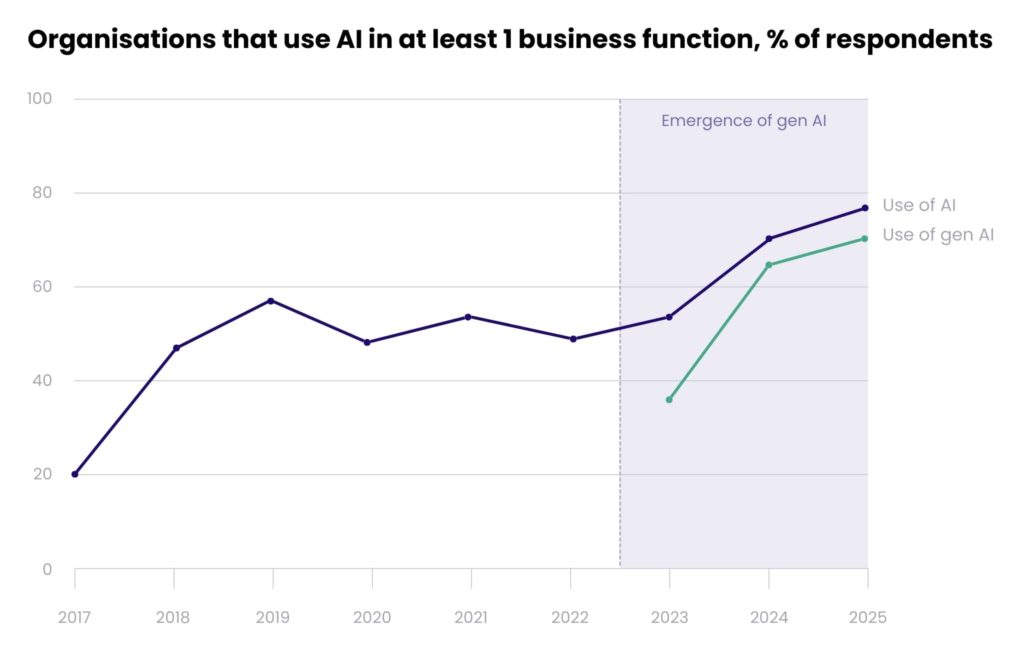
Many companies have adopted horizontal use cases like enterprise copilots and chatbots. Microsoft 365 Copilot is already used by nearly 70% of Fortune 500 companies. These are productivity boosters – they help employees save time on repetitive tasks and synthesise information. But the benefits are spread across the workforce and don’t show up in the top or bottom line.
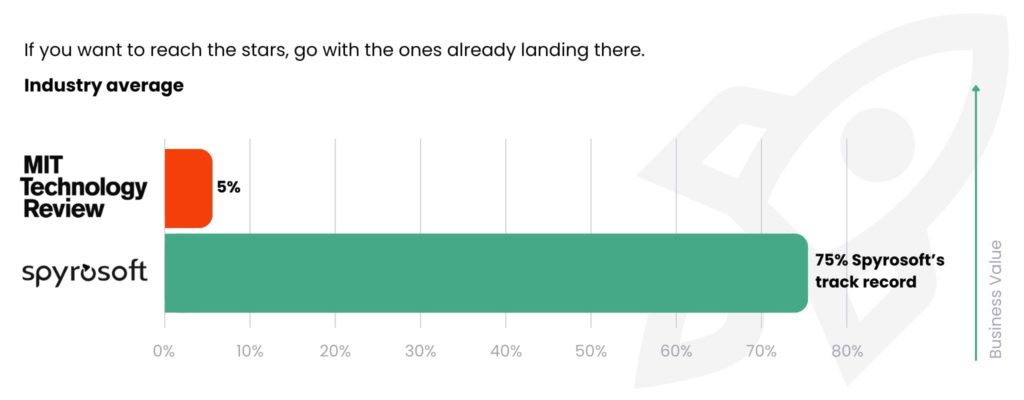
Vertical use cases tell a different story. These are embedded in core business functions and processes and can deliver measurable economic impact. But scaling them has been hard: less than 10% of such initiatives make it past the pilot stage. Even when deployed they often only address a narrow step in a process and require human prompting rather than operating proactively or autonomously. So, their impact on overall business performance is far below what’s possible.
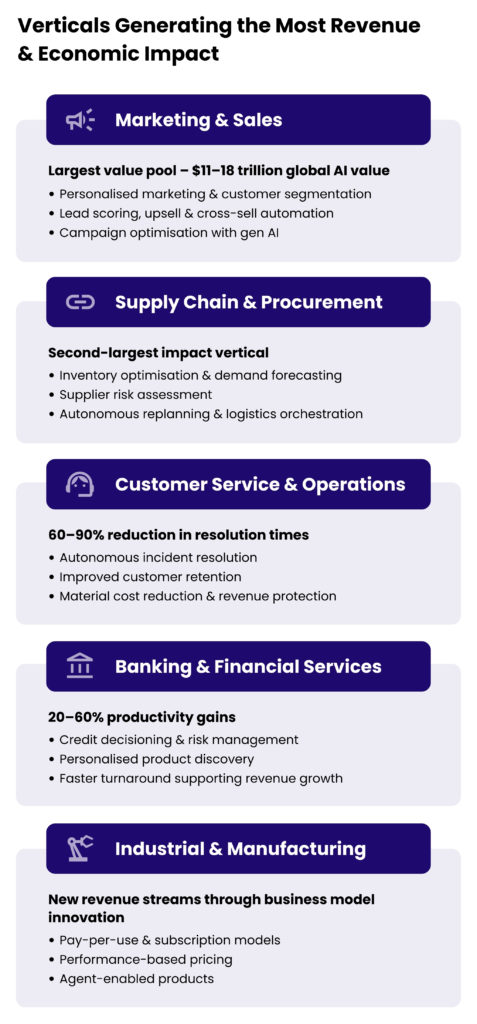
So why does this imbalance exist?
Both horizontal and vertical AI require deliberate decisions and structured enablement. However, horizontal tools are typically easier to deploy at scale, while vertical use cases demand targeted redesigns of workflows and operating models. As a result, their adoption faces six major barriers:
Fragmented initiatives
In many organisations, vertical use cases have emerged from a bottom-up approach within individual functions. Because fewer than one-third of CEOs actively sponsor their company’s AI agenda, this often results in a patchwork of disconnected micro-initiatives and dispersed investments. Without strong enterprise-level coordination, efforts remain fragmented and fail to generate transformative impact.
Limited availability of packaged solutions
Unlike horizontal applications such as copilots, which can be deployed largely off the shelf, vertical use cases often require deeper customisation and closer alignment with domain-specific workflows. Teams often need to stitch together multiple components and customise them heavily, effectively doing near-from-scratch development. While many organisations have data scientists capable of building models, what is often missing are the roles that bridge business requirements with technical execution – AI consultants, analytics translators, or AI product managers.
These specialists play a crucial part in connecting frontline workers, project sponsors, and AI engineers, ensuring that solutions are not only technically sound but also directly embedded in the realities of daily operations. Without this connective layer, even the best models risk remaining isolated experiments rather than becoming scalable business solutions.
See how we can streamline your operations with AI solutions
Technological constraints of early LLMs
Despite their remarkable capabilities, first-generation large language models (LLMs) carried limitations that restricted enterprise deployment. They could produce inaccurate outputs, undermining trust in precision-critical environments. They were also fundamentally passive: unable to act independently, drive workflows, or make decisions without prompts. Handling complex, multi-step workflows with branching logic proved difficult, as did maintaining context across extended interactions due to limited memory.
Another weaker side of early LLMs was security.
Sensitive data entered external systems could easily be exposed or misused, raising concerns around confidentiality, compliance, and regulatory risk. Moreover, the models themselves were vulnerable to prompt injection, data poisoning, or adversarial manipulation, creating potential vectors for misinformation or malicious outputs. Without robust access controls, auditability, and mechanisms to ensure data governance, organizations struggled to trust early LLMs in security-critical environments such as financial services, healthcare, or industrial operations.
This lack of embedded security made it clear that deploying LLMs at scale would require new architectures, stronger guardrails, and enterprise-focused design principles.
Siloed AI teams
Many enterprises struggle with AI initiatives because they are developed in isolation.
Too often, a central AI or R&D team spends months building a solution, only to present it to business users at the end with a “now use it” expectation. On production lines in automotive, for example, innovations are handed over from R&D but turn out to be disconnected from the realities of day-to-day operations, simply because frontline workers were never engaged in the design process.
The same pattern repeats across industries: models built without input from IT, data, or business teams may work in a controlled prototype but prove brittle, over-engineered, or misaligned once tested in live environments.
Data accessibility
Structured data is often scattered across multiple systems without consistent governance, while unstructured information, such as documents, emails, logs, and media, remains largely uncatalogued and underutilised.
The result is not only inefficiency, with teams spending time searching for usable inputs, but also a missed opportunity to turn data into a real business asset. The challenge is less about achieving real-time freshness everywhere and more about identifying and prioritising the data sources that truly fuel business value. In the past, companies often embarked on multi-year “big bang” initiatives, building vast data lakes first and hoping relevant use cases would follow.
Many of those efforts consumed significant resources but failed to deliver tangible results. Today, the approach has shifted: data platforms are built incrementally, with the focus on bringing in the data required for the most impactful use cases first, proving value, and then adding new sources over time.
Organisations that strategically define which data assets underpin their critical use cases, assign clear ownership, and invest in improving their quality build a foundation that scales. When sequenced well, early AI projects can improve the data assets that later use cases also depend on: accelerating deployment, reducing duplication of effort, and amplifying long-term impact.
If you need help with this, make sure you check our data and business intelligence services.
Cultural resistance and organisational inertia
Even when the technology is mature, people can still slow down progress. You can, however, avoid this with the right approach.
Many AI deployments encounter quiet resistance from business teams and middle management, driven by concerns about disruption, uncertainty around job impact, or limited familiarity with the technology. This hesitation can delay adoption and make integration into daily operations more difficult, but it is not a dead end.
Anticipating these barriers early and recognising that organisational culture must evolve alongside technology is essential. The key is not only to ask how do we add AI? but also how should processes adapt when intelligent software can act?, a mindset shift that lays the groundwork for moving beyond prototypes toward scaled, meaningful impact.
Think of the shift that happened when spreadsheets arrived for accountants. Before, calculations were done manually on paper or with a calculator. Accurate but painfully slow. Spreadsheets didn’t just make the same work faster, they expanded what was possible: complex models, instant recalculations, and entirely new ways of analysing data.
If we treat it as just another tool to make existing processes a bit more efficient, we miss the point. The real opportunity lies in reimagining workflows, decisions, and roles around intelligent software, unlocking value that simply wasn’t possible before.
AI agents for business: From reactive tools to autonomous collaborators
Turning organisational processes upside-down can harm your organisation. Therefore, the adoption of AI should be balanced. One way to make it sustainable and profitable is to consider implementing AI agents, which are key concept in scaling AI.
AI agent is a software entity that combines learning, memory, and decision-making to perform tasks end-to-end.
Unlike a simple chatbot or analytic model, an AI agent can plan, act autonomously across systems, and continuously improve. As IBM notes, unlike traditional or generative AI, AI agents possess the ability to make complex decisions autonomously, plan, and interact dynamically across systems.
In business, agents can literally change the world by automating multi-step processes and serving as proactive collaborators. They are enablers that transform AI into a goal-driven virtual collaborator.
In McKinsey, OpenAI, Microsoft, Anthropic, and academic definitions, the core features are:
- Autonomy (can take actions without a human prompting every step)
- Planning (can sequence actions toward a goal)
- Memory/state
- Tool & system integration
- Decision-making
By combining these, AI agents shift work from reactive responses to proactive assistance. For example, instead of a support agent waiting for a user’s query, an agent might automatically resolve recurring customer issues, alert teams to anomalies, or suggest strategic business moves. In short, agents become decision support engines that work with humans.
How is AI used in business
The following stories show what can be done and how different companies implement AI agents in their organisations. Here are example use cases implemented by other companies and us, Spyrosoft.
Case study 1: Transforming customer service with an AI agent
The problem: Our client, a global leader in the paints and coatings industry, needed a customer support solution that could scale across markets. Their HubSpot-based chatbot struggled to support multiple languages and websites, offered limited knowledge base automation and proved inefficient in handling growing customer query volumes.
The solution: We delivered an AI-driven chatbot designed for multilingual, multi-platform customer support. The solution scales smoothly across regions, automatically builds and updates the knowledge base, reduces manual effort and integrates with internal systems to ensure reliable data flow. By using advanced AI, the chatbot provides personalised, context-aware interactions that help customers find answers faster and support teams focus on higher-value tasks.
The result:
- +150%
- Increase in automation compared to the previous HubSpot chatbot
- 2× fewer escalations
- To human agents
- 3× reduction in unresolved cases
- Improving first-contact resolution
If automating customer support is something you consider, make sure you read our take on AI technical support.
Case study 2: Insurance underwriting at scale
The problem: Insurance underwriters at Compensa were bogged down by broker inquiries, manual offer processing, and slow turnaround times, limiting productivity and customer responsiveness.
The solution: Spyrosoft, in cooperation with Compensa, created an AI underwriting solution to support underwriting by responding to broker requests, processing offers, and providing faster, more accurate responses. By embedding domain knowledge into the agents, the system replicated underwriter expertise across the team.
The result:
- 2× increase in underwriting efficiency
- 5× faster response times across underwriting workflows
- 2× more offers processed within the same operational capacity
- Recognised as a top-three global innovation within the organisation
- Direct contribution to revenue growth
Case study 3: Reimagining credit-risk memos in banking
The problem: Retail bank relationship managers were spending weeks drafting credit-risk memos to support lending decisions. Each memo required manually pulling data from at least ten different sources and weaving together complex reasoning across interdependent sections such as loans, revenue, and cash flow, slowing decision-making and frustrating both staff and customers.
The solution: The bank collaborated with credit-risk experts to build a proof of concept powered by AI agents. These agents extracted data, drafted memo sections, assigned confidence scores to highlight areas for review, and suggested follow-up questions. Instead of manually compiling documents, relationship managers shifted into roles of strategic oversight and exception handling.
The result:
- 20–60% increase in productivity across the credit approval workflow
- Nearly 30% reduction in approval turnaround time
- Faster and more accurate decisions with fewer manual errors
- Greater focus on value-added human judgement
Case study 4: Elevating data quality in market research
The problem: A market intelligence firm employed over 500 analysts to clean, structure, and codify massive amounts of data. Despite this investment, errors persisted – 80 percent of mistakes were still being spotted by clients. The process was costly, resource-intensive, and left little time for analysts to focus on generating deeper insights.
The solution: The company piloted a multi-agent system designed to autonomously detect anomalies, explain shifts in sales or market share, and identify drivers of change. The agents cross-referenced internal data such as taxonomy updates with external signals like product recalls or weather events. They then synthesised and ranked the most influential factors, providing ready-to-use insights for decision-makers.
The result:
- Over 60% potential productivity gain identified
- More than $3M in expected annual savings
- Analysts redirected to higher-value, strategic work
- Improved accuracy and depth in data processing through AI agents
Case study 5: Automating back-office operations in financial services
The problem: Global banks face mounting costs and inefficiencies in their back-office operations, from underwriting to compliance checks. Manual processes are slow, prone to error, and consume significant resources.
The solution: One large insurer, AIG, partnered with Palantir to deploy 78 AI agents dedicated to underwriting.
The result: Learn more.
- Process time reduced from two days to three hours
- Faster and more accurate decision-making
- AI agents enabling new, scalable operating models beyond cost reduction
Case study 7: Reinventing logistics and supply chain operations
The problem: A U.S. freight company was drowning in paperwork. Pickup orders, bills of lading, and shipment updates were handled manually, leading to errors, delays, and missed shipments.
The solution: AI agents were introduced to digitise orders, process bills of lading, and update shipment statuses automatically. By removing the human bottleneck, the system created an always-on, error-free process for document handling.
The result:
- 98–99% accuracy achieved across order processing
- Significantly reduced response times
- Near elimination of missed orders
- Transition from manual paperwork to a scalable, always-on system
- Staff freed to focus on exceptions and customer service
Case study 8: Modernising legacy banking systems
The problem: A global bank faced the daunting task of modernising its legacy core platform, made up of more than 400 separate applications. The project carried a $600 million budget and was slowed by siloed teams working through repetitive, manual tasks. Documentation was slow, error-prone, and difficult to coordinate, leaving the transformation effort stuck in complexity.
The solution: The bank adopted an agentic approach, where squads of AI agents collaborated under human supervision. Each agent was responsible for a defined stage, documenting existing applications, generating and reviewg code, integrating features, and testing outputs. Human experts guided the process, ensuring quality and strategic alignment while offloading repetitive coding and documentation tasks to the AI.
The result:
- Over 50% reduction in development time and effort for early-adopter teams
- Manual work automated, with people moving into supervisory roles
- Faster modernisation cycles and feature delivery with fewer sprints
Building an AI adoption roadmap
Replicating these successes can be easier with a clear roadmap. AI adoption at scale is not just a technical upgrade. It’s a business transformation.
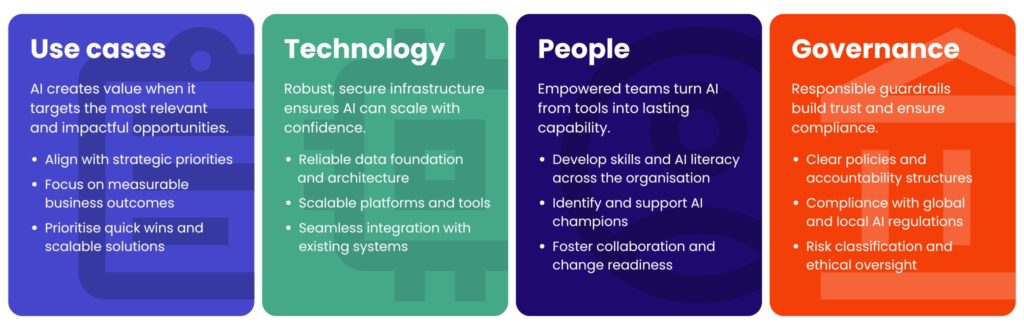
Drawing on industry best practices, you should consider steps like the following:
1. Focus on high-value use cases
AI only delivers lasting impact when it is tied to real business outcomes. Start by aligning initiatives with strategic priorities and measurable goals, whether that’s reducing call resolution times, improving throughput, or cutting error rates. Prioritise quick wins that demonstrate value early, while designing solutions with scalability in mind.
2. Build scalable, secure technology foundations
A strong data and technology backbone is critical for adoption at scale. Invest in a modular, extensible architecture, a shared ecosystem where reusable AI agents can plug into common platforms, APIs, and governance layers. Ensure seamless integration with existing systems, supported by reliable data pipelines and secure, observable infrastructure that users can trust.
3. Empower people and culture
Technology succeeds only when people adopt it. Promote AI literacy across the organisation, equip teams with the skills to work effectively with AI agents, and create cross-functional squads that blend IT, operations, and business expertise. Involve end users early, identify AI champions, and openly communicate goals to build trust and readiness for change.
4. Establish responsible governance and continuous evolution
Trust and accountability must be built in from the start. Define clear policies, ethical guardrails, and oversight mechanisms for how AI agents operate, make decisions, and use data. Set up monitoring to track agent performance, collect feedback, and adapt over time. Treat every deployment as a learning lab, refining workflows, retraining models, and scaling what works.
Turning AI potential into reality
The era of AI has arrived at boardroom agendas, but the winners will be those who go beyond plugging in the latest tools. Leading organisations are not just adding AI as a sidekick but also redesigning themselves around it. The era of agentic enterprises is here.
You must think about changing your processes in an environment where software can act. This requires reimagining workflows from the ground up, making AI agents central to how value is created.
In practical terms, success depends on strong intent: define clear outcomes, embed AI (and AI agents for business) deeply into core processes, and realign teams and metrics accordingly. When done right, the payoff can be dramatic. For example, X-genie lets underwriters process twice more offers and deliver them five times faster. Similarly, firms that built centralised AI platforms achieved faster adoption and lower costs per use case.
The path forward is one of both ambition and rigor. Invest in modular platforms and cross-functional teams, set up governance and skills programs, and use AI agents as instruments of business change, not just nice-to-have features.
By thoughtfully integrating AI, and especially by leveraging AI agents within core processes, you can move from isolated pilots to enterprise-wide impact. In doing so, you will turn the promise of AI into a competitive advantage, transforming not just tasks but entire business models.
Implementing AI with Spyrosoft
At Spyrosoft, we’re working on AI strategies and solutions for industries daily. We can advise you on AI strategy that will supercharge your operations, shaping roadmaps and defining way forward.
Whether you’re developing AI agents, modernising core applications, or integrating advanced analytics into your operations, our team delivers end-to-end solutions, from strategy and prototype to deployment and scaling.
if you want to become an agentic enterprise, we’ll be happy to help you out.
FAQ
AI in technical support refers to the use of artificial intelligence and machine learning technologies to automate or enhance customer service operations and tech support. This includes utilising tools such as chatbots, virtual assistants, knowledge bases, predictive analytics, and AI agents and copilots.
AI is used to automate responses, categorise and prioritise tickets, assist human agents, provide 24/7 support, and analyse customer behaviour for improved support delivery. It helps manage customer inquiries, provide instant responses, offer personalised recommendations, and even predict future issues based on historical data – significantly improving response times and overall customer experience.
Key benefits of using AI in technical support include faster response times, 24/7 availability, and the ability to handle large volumes of repetitive queries without human fatigue. AI-driven systems can also reduce operational workload by automating routine tasks and improving issue resolution accuracy through data-driven insights. This leads to a more consistent and scalable customer experience while freeing human agents to focus on more complex and strategically important problems.
AI can enhance all levels of technical support by automating and optimising different tasks based on complexity. In L1 support, AI-powered chatbots and virtual assistants can handle common queries, reset passwords, and provide basic troubleshooting. For L2, AI tools can assist human agents by analysing logs, suggesting solutions, and automating diagnostics. In L3 support, AI can support engineers by identifying patterns in large datasets, accelerating root cause analysis, and even predicting recurring system issues before they escalate.




Let’s discuss how we can support your AI projects

Tomasz Smolarczyk
Director of Artificial Intelligence