From ERP to AI-ready operations: Food processing system integration in practice

Most food processors do not lack software. They already run enterprise resource planning (ERP), manufacturing execution systems (MES), warehouse management systems (WMS) and quality applications, often alongside plant historians, spreadsheets and supplier-facing tools. The difficulty is that these applications do not share responsibility, identifiers, or event data consistently. Food processing system integration addresses that gap without forcing a risky enterprise-wide replacement. It creates a governed route through which production, quality, warehouse, supplier, sustainability, and AI use cases can use the same operational facts.
Food processing system integration is an architectural approach that connects operational and enterprise applications while preserving systems that still perform their jobs well.
Why is ERP replacement usually the wrong starting point?
ERP replacement is usually the wrong starting point because the operational gap sits between systems, not solely inside the ERP. A modern ERP can improve finance, procurement, and planning, yet it will not automatically absorb plant-floor execution, laboratory workflows, warehouse events, supplier evidence or equipment telemetry. Replacing it before defining data ownership can reproduce the same integration problems on a newer platform.
- An ERP is designed to manage enterprise transactions.
- A MES records what happened during production.
- A LIMS governs samples, methods and approved test results.
- A WMS tracks stock, locations and handling units.
- A quality management system (QMS) manages deviations, corrective and preventive actions, audits and controlled procedures.
Each application exists because a different operational domain needs specialised behaviour.
The architectural error is asking one system to become the master of everything. When ERP or MES platforms take on responsibilities outside their intended domains, customisations accumulate, ownership and inherited responsibilities are unclear, and upgrades become difficult. The result is not a simplification. It is a larger monolith with unclear boundaries.
A better first step is to establish which system is authoritative for each object and event. The integration layer then distributes validated information to the systems that need it, without creating competing masters. This follows the practical direction outlined in Spyrosoft’s earlier analysis of why large food processors lose control of operational data: connect what works, digitise missing interfaces and replace only what cannot be made safe, supportable or fit for purpose.
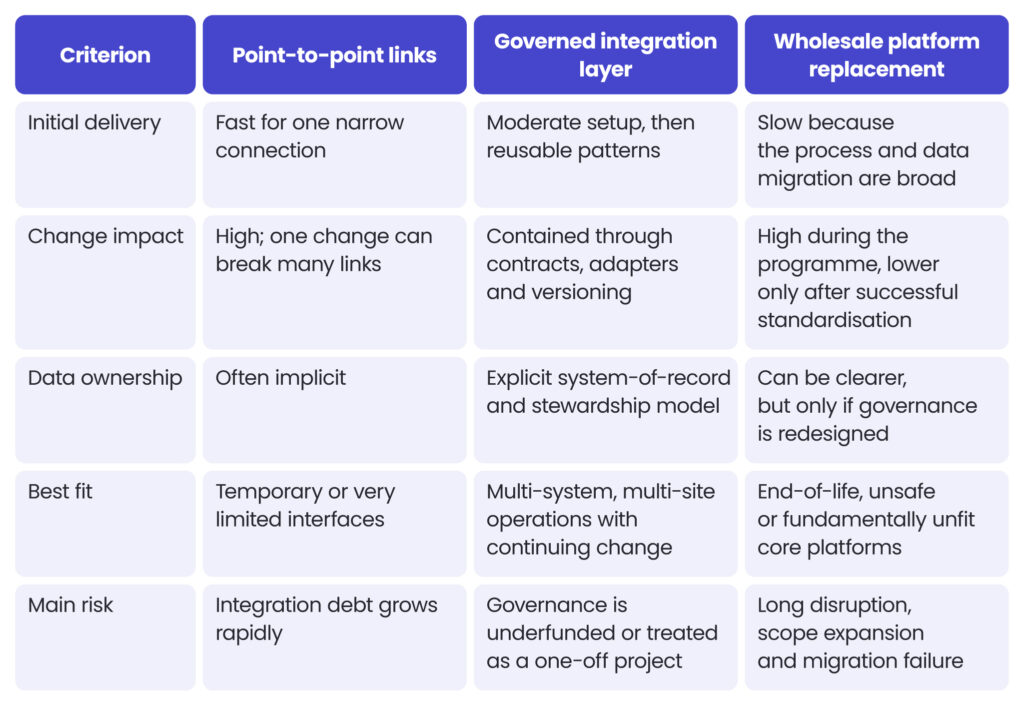
There are valid reasons to replace a core system. Replacement becomes sensible when the vendor has ended support, cybersecurity exposure cannot be mitigated, data cannot be extracted reliably, the platform cannot handle the operating model, or the cost of maintaining customisations exceeds the cost and risk of migration. Integration should not be used to preserve a structurally unsafe system.
The position should be explicit: buy a new core platform only after proving that architecture, process ownership and interface design cannot solve the priority business problem. Otherwise, a replacement programme may take years, while traceability, quality, and reporting teams continue to work around the same gaps.

What does a sound food processing system integration architecture look like?
A sound food processing system integration architecture separates transaction ownership, data exchange, analytical storage and user-facing workflows. It does not create another master system by accident. Instead, it gives every application a defined role, translates data through governed contracts and records the lineage required to explain where each operational fact came from.
A practical data architecture for food manufacturers normally has six layers. Source applications execute business processes. The integration plane moves commands and events. A canonical data and identity layer resolves meaning across systems. An operational data platform stores harmonised history for reporting and AI. User applications support decisions and external collaboration. Security, observability, and governance apply across every layer.
This structure aligns with the intent of ISA-95 and IEC 62264, the international framework for integrating enterprise and manufacturing control systems. The standard separates business planning and logistics from manufacturing operations management and defines the information exchanged across that boundary. It is useful because it gives IT, operations, and automation teams a common vocabulary before technology choices begin.
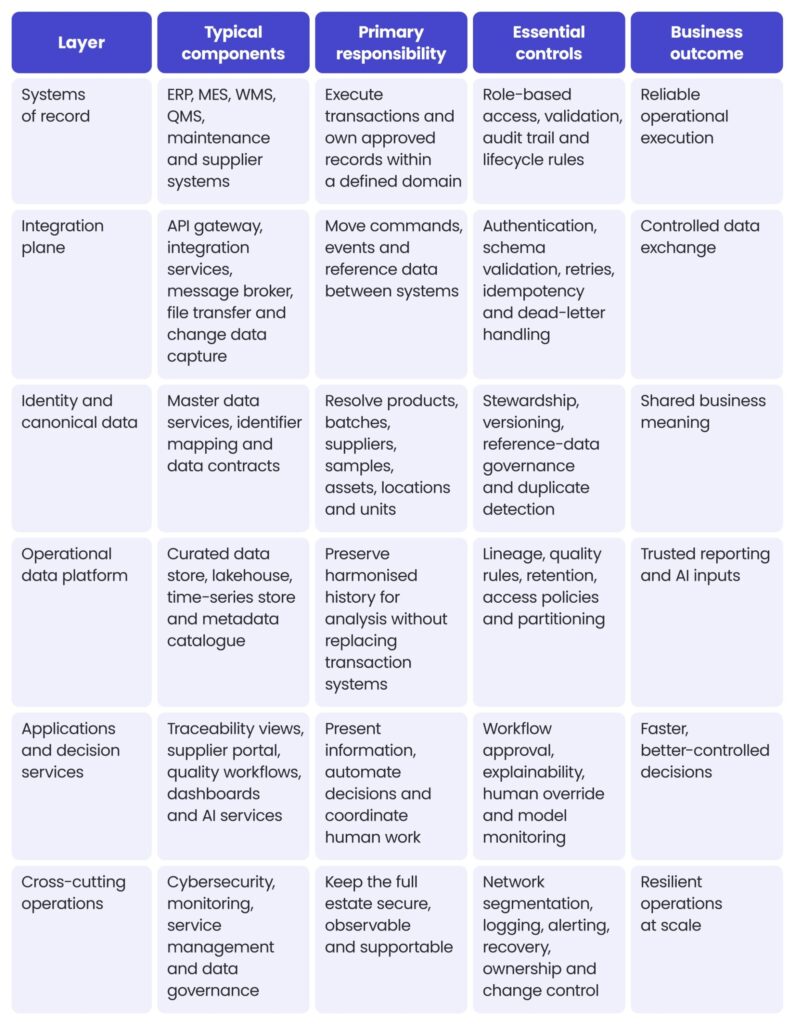
The integration plane should be independent enough to survive changes in individual applications. If the MES is upgraded, downstream consumers should not all require redesign. If a second plant uses a different LIMS, the canonical contract should absorb local variation. This is why data contracts matter as much as middleware products.
A canonical model is not a requirement to place every record in one database. It is an agreed representation used during exchange. For example, each plant may retain its local production order number, while the integration layer maps it to a group-wide production order identifier and records the relationship. The same principle applies to supplier codes, product versions, sample numbers and packaging handling units.
The architecture can be on-premises, cloud-based or hybrid. Plant-critical functions should not depend on an external service if loss of connectivity would stop safe production. Central analytics, cross-site reporting, and model training are often suitable for cloud infrastructure, while local gateways, plant integration services, and buffering protect continuity. The boundary should reflect latency, safety, resilience, and support requirements rather than a blanket cloud policy.
Which integration pattern fits each operational flow?
The right food processing system integration pattern depends on the business consequence of delay, the source system’s capabilities, and the volume of change. APIs suit direct queries and commands. Events suit changes that several consumers must observe. Batch exchange remains appropriate for large, non-urgent data sets. Robotic process automation should be a controlled exception where no stable interface exists.
Use a synchronous API when one system needs an immediate answer, such as checking whether a batch has been released before allocation. Set a strict timeout and define what happens if the dependency is unavailable. Production should not wait indefinitely for a remote service.
Use event-driven architecture for state changes such as “goods received”, “sample collected”, “test approved”, “batch consumed”, “pallet created” or “shipment dispatched”. Producers publish facts once; authorised consumers respond independently. Message ordering, duplicate handling and replay behaviour must be designed before launch.
Managed batch exchange works well for nightly reference-data synchronisation, large historical extracts or external partners without API support. Files still need schemas, checksums, encryption, acknowledgement, quarantine, and support ownership. “Send a CSV” is not an integration design unless error handling is defined.
Change data capture can expose updates from a legacy database when the application has no usable API, but it should not bypass business semantics carelessly. A changed row does not always equal an approved business event. The food processing architecture integration may need rules that translate low-level changes into meaningful, validated events.
At the plant level, Open Platform Communications Unified Architecture (OPC UA) can provide secure, platform-independent information exchange across industrial devices and systems. Message Queuing Telemetry Transport (MQTT) is useful for lightweight publish-and-subscribe telemetry, especially where gateways buffer data or network quality varies. Neither protocol replaces a business data model.
The most durable pattern combines API-led access with event-driven operations. An API gateway protects and governs direct services. A broker distributes state changes. Integration services translate system-specific payloads into canonical contracts. A catalogue records ownership, versions, dependencies and service-level objectives.
Observability is mandatory. Teams need a single view of message failures, processing latency, schema errors, queue depth and replay status. An integration that fails silently is worse than a manual process because users assume the data is current.
How does traceability become a data product rather than an audit exercise?
Traceability becomes a data product when every relevant movement and transformation creates a structured, searchable event linked to stable identities. The organisation can then reconstruct product history continuously, not assemble it only during a mock recall or customer audit. The traceability view is generated from operational events rather than maintained as a separate spreadsheet.
Article 18 of Regulation (EC) No 178/2002 requires food and feed businesses to identify who supplied them and the businesses to which products were supplied. Many processors need deeper internal genealogy to meet customer requirements, certification schemes and risk management objectives. The architecture should distinguish the legal minimum from the operational capability the business chooses to build.
A traceability event should answer five questions:
- What object or quantity was involved?
- When did the event occur, and when was it recorded?
- Where did it occur, including site, line, vessel, warehouse zone, or external location?
- Why did it occur, such as receiving transformation, hold, release, rework, or dispatch?
- Which process, user, machine or business transaction provides the evidence?
GS1’s Electronic Product Code Information Services (EPCIS) and Core Business Vocabulary (CBV) provide a standard way to express and exchange visibility events across enterprises. Food processors do not have to adopt every GS1 element to benefit from the model. The important principle is to represent objects, locations, business steps, dispositions, and transformations consistently.
Batch genealogy must support forward and backward queries
A backward query starts with a finished product or shipment and identifies ingredients, packaging, production orders, laboratory approvals and suppliers. A forward query starts with an incoming lot or packaging batch and identifies all affected intermediates, finished products, locations, and customer dispatches.
Splits, merges, and rework need first-class treatment. A raw material lot may be divided across several production runs. Multiple lots may enter a blend. Rework may re-enter a later batch. If the system records only the final product code and date, the genealogy will appear complete until a real investigation exposes missing relationships.
Enhance traceability for food processing system integration
Food traceability software should sit above reliable execution events. A dashboard cannot repair missing material-usage records, inconsistent timestamps, or unlinked rework. Integration improves food supply chain visibility only when the underlying events are captured at the source and validated against shared identities.
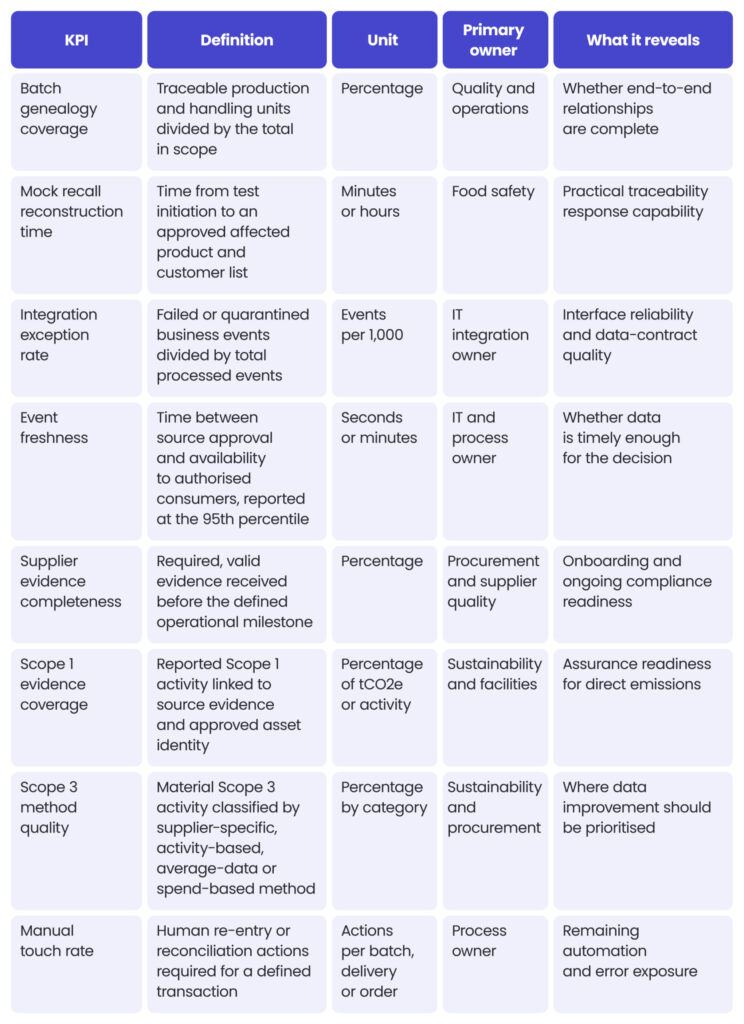
Useful traceability KPIs include genealogy coverage, time to reconstruct a mock recall, percentage of handling units linked to a production batch, event latency, unresolved mapping exceptions, and the quantity difference between issued, consumed, produced and dispatched material. These measures reveal where the chain is weak before an incident occurs.
How can the same architecture support Scope 1 and Scope 3 reporting?
The same architecture for food processing system integration can support Scope 1 and Scope 3 reporting by turning energy, fuel, refrigerant, procurement, logistics, packaging, waste, and supplier records into governed activity data with traceable calculation methods. The reporting output is produced from versioned evidence, rather than assembled each year from disconnected spreadsheets and email attachments.
Scope 1 covers direct greenhouse gas emissions from sources owned or controlled by the reporting organisation.
The relevant records include:
- stationary fuel combustion
- company-controlled vehicles
- refrigerant leakage
- process emissions, where applicable
The source evidence often sits in utility systems, maintenance logs, fleet systems, invoices, meter readings and plant records.
Scope 3 covers other indirect value-chain emissions across the 15 GHG Protocol categories.
Material categories for a processor often include:
- purchased goods and services,
- fuel- and energy-related activities not included in Scope 1 or 2,
- upstream and downstream transport, waste generated in operations,
- capital goods and the treatment,
- use of sold products where relevant.
Materiality and reporting boundaries must be assessed for the individual organisation.
The data architecture should create an emissions activity record with at least these fields:
- activity type and reporting category;
- quantity and unit;
- activity date and reporting period;
- facility, asset, supplier, product, batch or shipment relationship;
- source system and original evidence reference;
- calculation method;
- emission factor identifier, source, geography, year and version;
- conversion logic and resulting tonnes of carbon dioxide equivalent (tCO2e);
- data quality status, uncertainty note and responsible owner;
- approval and restatement history.
Keep activity data separate from emission factors. A logistics record may remain valid while the factor or method changes. If the factor is overwritten inside a spreadsheet, the organisation cannot reproduce a prior report. Versioning allows recalculation while preserving the evidence and method used in the published period.
Scope 1 needs strong asset and meter identity. A gas invoice should map to the correct site, meter, and period. A refrigerant top-up should link to an equipment asset, refrigerant type, quantity, service event, and technician record. Missing asset relationships create avoidable manual reconciliation during assurance.
Scope 3 needs a staged data-quality strategy. Supplier-specific activity or product data may provide better precision, but only when boundaries, units, and methodology are comparable. Secondary data, such as spend-based or average-data methods, can provide an initial inventory where primary data is unavailable. The system should record which method was used and support a planned move towards higher-quality activity data for material categories.
Updates to EU sustainability reporting rules
European sustainability reporting requirements changed materially in 2026. Directive (EU) 2026/470 narrowed the CSRD scope to undertakings with more than 1,000 employees and net annual turnover above EUR 450 million, subject to national transposition. At the time of writing in June 2026, the revised European Sustainability Reporting Standards (ESRS) were still in the Commission’s adoption process. Organisations should verify the applicable national rules and final standards before publication.
The operational case remains even for companies outside the mandatory CSRD scope. Retail customers, lenders, investors, and larger value chain partners may request emissions evidence. A processor that can retrieve activity data, source documents, and calculation lineage can respond with less manual effort and lower risk of inconsistent answers.
The GHG Protocol Corporate Value Chain (Scope 3) Standard provides the recognised framework for the 15 categories and calculation boundaries. The European Commission’s 2026 explanation of the CSRD value-chain cap clarifies how information requests to smaller value-chain partners should be limited for CSRD purposes.
What makes operational data genuinely AI-ready?
Operational data is AI-ready when it is reliable enough to support a defined decision, not merely available in a data lake. Models need stable identities, timestamps, provenance, labels, context, and feedback. The organisation also needs controls for access, versioning, monitoring, and human intervention once a model influences production or quality work.
Base your integration decision on a quality risk assessment
Predicting quality risk before release requires different data from forecasting demand or detecting equipment anomalies. The use case should define the prediction horizon, action owner, acceptable delay, costs of false positives and false negatives, and the fallback when the model is unavailable.
AI in food processing commonly draws on several domains:
- incoming material attributes, supplier history and seasonality;
- process parameters, alarms, downtime and line conditions;
- laboratory results and quality decisions;
- yield, giveaway, scrap and rework;
- maintenance records and sensor trends;
- warehouse dwell time, temperature and dispatch conditions;
- complaints, returns and product specifications;
- energy, water and cleaning-cycle data.
Those sources become useful only after identities and time are reconciled. A laboratory result must link to the correct sample and batch. A sensor value must identify the asset, engineering unit, calibration state, and timestamp quality. A complaint must map to the product and production context that existed when the item was made.
Data leakage is a frequent hidden defect. A model trained to predict a failed quality release may accidentally use a field that is populated only after the laboratory decision. It will appear accurate in development and fail in live use. Feature availability must therefore be tested at the actual decision time.
Data quality in AI-related food processing system integration
Ground truth also matters. If operators record defect reasons inconsistently, the model will learn the recording behaviour rather than the production process. A short data-definition and labelling programme may create more value than an immediate algorithm competition.
Model operations need version control, validation, deployment approval, monitoring, and rollback. Teams should track prediction quality, data drift, missing features, intervention frequency, and downstream outcomes. A model that is accurate on average may still be unsafe in a rare allergen, temperature, or contamination scenarios, so high-consequence decisions need explicit rules and qualified human review.
The NIST AI RMF guideline
The NIST Artificial Intelligence Risk Management Framework emphasises validity, reliability, transparency, security, and data provenance. ISO/IEC 42001:2023 provides a management-system approach for organisations that develop, provide, or use AI. These frameworks are useful even when a specific use case is not classified as high risk under legislation, because they force ownership and lifecycle controls into the programme.
A food processor is not AI-ready because it has purchased an analytics platform. It is ready when the business can explain:
- Which data supported a decision?
- Which model version ran?
- What the output meant?
- Who reviewed it?
- What happened afterwards?
What should the implementation programme look like?
The implementation programme for food processing system integrations should begin with one business-critical vertical slice and create reusable architecture around it. The aim is to prove ownership, event capture, exception handling, and operational value across real systems. A broad “connect everything” initiative creates activity but often postpones the first usable outcome.
Step 1. Select a decision and define the operating outcome
Choose a use case with measurable operational pain, clear ownership, and data crossing several systems. Good candidates include batch release, mock recall, incoming-material approval, supplier onboarding, or production-yield analysis. Define the decision, users, current lead time, failure modes, and target service level.
Step 2. Map the current flow at the event level
Document where each fact originates, who approves it, how it moves, and where manual re-entry occurs. Include spreadsheets, emails, printed forms and informal calls. System diagrams alone rarely capture the real process.
The output should include a source-to-consumer map, a system-of-record matrix, an identifier inventory, an interface catalogue, and an exception list. Interview plant users during live work where possible. The workaround used on a night shift may not appear in a standard operating procedure.
Step 3. Define identities, ownership, and data contracts
Agree on enterprise identities for batch, material, product version, supplier, sample, asset, location, handling unit, order, and shipment. Define mandatory fields, units, status values, timestamps, and correction behaviour. Assign a business data owner and a technical service owner to every contract.
Do not postpone governance. An interface built before ownership is agreed will encode local assumptions that become expensive to remove.
Step 4. Establish the food processing system integration foundation
Deploy the minimum reusable components: authentication, API management, messaging, schema validation, secrets management, observability, deployment pipelines, and secure connectivity. Select technology that fits support skills and plant constraints. Product selection should follow architecture, not replace it.
Network boundaries need specific attention. Plant systems, enterprise applications, remote suppliers, and cloud services should not share unrestricted trust. Security controls should include least privilege, certificate or key rotation, logging, segmentation, backup, restore testing, and incident ownership.
Step 5. Deliver one end-to-end vertical slice
Connect the chosen flow from the source event to the user decision. For batch release, this might include the MES production-complete event, LIMS result approval, QMS hold status, ERP stock state, and WMS allocation control. Build the operational view and exception workflow at the same time.
Run parallel validation against the current process. Reconcile differences until the new flow is trusted. Acceptance should test late messages, duplicate events, amended results, network interruption, clock errors, rework, and partial system outage, not only the happy path.
Step 6. Extend the supplier boundary
Introduce the supplier portal or machine-to-machine channel only for data required by the use case. Begin with a representative supplier group that includes at least one partner with limited digital capabilities. Measure completion, support demand, rejection reasons, and time to approval.
Create a clear operating model:
- Procurement owns participation;
- Supplier quality owns data acceptance;
- IT owns availability and access;
- Data governance owns definitions.
Without that division, the portal becomes an IT helpdesk for business decisions.
Step 7. Build the analytical and AI layer
Replicate governed events and reference data into the operational data platform. Add quality checks, lineage, metadata, and retention. Create features only after the source contracts are stable enough to reproduce historical states.
Pilot one decision-support model with a human-in-the-loop workflow. Compare the model against a defined baseline, record interventions, and monitor outcomes. A production model needs an owner, validation evidence, a release process, and retirement criteria.
Step 8. Scale by pattern, not by custom project
Turn successful interfaces into templates for new plants, lines, laboratories, and suppliers. Reuse identity rules, event schemas, security controls, dashboards, and support procedures. Allow local adapters where systems differ, but keep canonical meaning consistent.
Operating funding must continue after delivery. Integration services require:
- monitoring,
- certificate renewals,
- schema change management,
- capacity planning,
- disaster recovery,
- vendor coordination.
Treat the integration layer as a product with a roadmap, not a completed installation.
For planning purposes, a focused discovery and target-architecture phase can be time-boxed to 8–12 weeks, depending on the number of sites and access to operational experts. The output should be a prioritised roadmap, not just a slide deck. It should identify the first vertical slice, system dependencies, data risks, security constraints, delivery team, and acceptance measures.
Which KPIs prove that food processing system integration is working
Integration is working when business decisions become faster, more complete, and more reproducible without increasing operational risk. Technical uptime alone is insufficient. The measurement set should combine data quality, process lead time, traceability performance, exception volume, user effort, and evidence coverage.
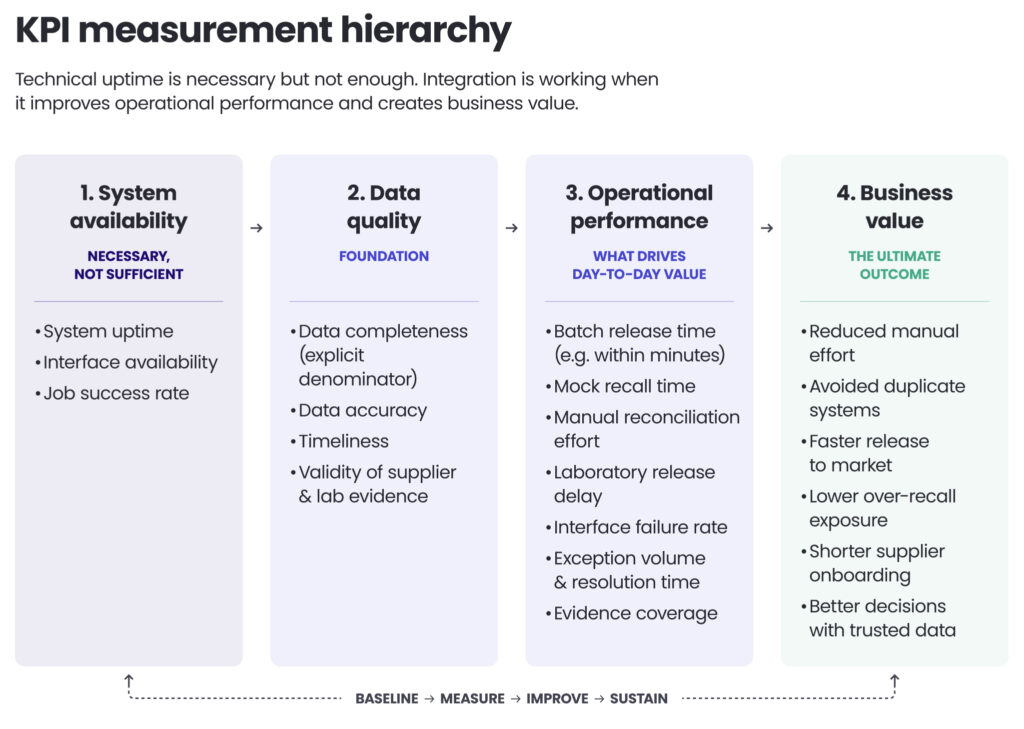
Start with a baseline before changing the flow. Otherwise, the programme can deliver new technology without proving an operational change.
Use service-level objectives where timeliness matters. A batch-release event may need to be available within minutes, while a monthly sustainability ledger can tolerate overnight processing. Reporting the 95th percentile is more informative than a simple average because it reveals slow or stuck events.
Data completeness should be measured against an explicit denominator. “Most suppliers submitted documents” is not a KPI. “Valid certificates received before first delivery for suppliers and materials requiring certification” is measurable because the population and deadline are known.
Quality measures need an exception workflow. A lower automated pass rate can be acceptable if the system correctly quarantines ambiguous records. The goal is not to hide exceptions; it is to identify, route, and resolve them before they contaminate downstream decisions.
Financial value can be estimated from reduced manual effort, avoided duplicate systems, faster release, lower over-recall exposure, and shorter onboarding. Revenue uplift should not be claimed unless the causal link is measured. For a consideration-stage business case, operational evidence is more credible than an aggressive return-on-investment headline.
Who benefits, and what decision should each group make?
Different leaders experience the same food processing architecture integration through different decisions. The programme succeeds when each group owns an outcome, a data set, and a change in working practice rather than treating integration as an IT-only initiative.
Operations directors and plant managers
The main problem is delayed or inconsistent decisions across production, quality, and warehouse teams. Integrated events show whether material is available, whether a batch has been released, and where work is blocked. Operations should prioritise the vertical slice with the highest downtime, spoilage, release, or manual-coordination impact and define the service level needed at the plant.
They should start collecting actual event timestamps, reason codes, line states, material-consumption confirmations, yield, scrap, rework, and manual intervention. These data support better decisions on scheduling, bottlenecks, changeovers, and exception ownership.
CIOs and enterprise architects
The main problem is integration debt across legacy, vendor, and plant-specific systems. A governed integration plane reduces direct dependencies and creates reusable contracts. The CIO should decide which capabilities must be strategic internal products, which can be managed services, and which legacy applications require containment or replacement.
Key data include interface inventory, dependency maps, failure rates, support effort, version lifecycles, security exposure, and total change cost. The architecture decision should balance plant continuity, standardisation, vendor constraints, and long-term ownership.
Quality and food safety leaders
The main problem is proving batch status, genealogy, and evidence under time pressure. Integrated traceability links production, laboratory, holds, supplier documents, and dispatch without local reconciliation. Quality leaders should define release rules, recall query requirements, evidence retention, and the exceptions that require qualified human approval.
They should collect sample-to-batch relationships, method versions, result approval history, hold reasons, deviation links, certificate validity, and mock-recall performance. Better data supports release, containment, root-cause analysis, and audit preparation.
Sustainability and finance leaders
The main problem is reproducing the Scope 1 and Scope 3 figures from the source evidence and the approved methodology. An emissions activity ledger separates operational activity from factor versions and calculation outputs. Sustainability leaders should prioritise material categories, define method hierarchies, and agree which supplier requests are necessary and proportionate.
They should collect quantities, units, dates, facilities, assets, suppliers, products, shipments, factors, uncertainty, and evidence references. Better lineage supports internal review, assurance and consistent responses to customers or lenders.
Procurement and supplier quality teams
The main problem is incomplete, late, or incomparable supplier information. A supplier interface gives each request a purpose, deadline, validation rule, and approval owner. Procurement should segment suppliers by risk and digital capability rather than impose one channel on everyone.
They should collect onboarding duration, rejection reasons, expired evidence, response time, data method, and support demand. These measures support supplier development, sourcing decisions, and realistic service design.
Data and AI leaders
The main problem is producing reproducible features from operational systems that change independently. The food processing integration architecture provides stable identities, historical states, and lineage. Data leaders should select use cases with clear decisions and feedback rather than building a broad feature store before business ownership exists.
They should collect label definitions, feature availability time, model version, prediction, confidence, human action, and realised outcome. Those records support validation, drift monitoring, and responsible model improvement.
Common mistakes to avoid during the food processing system integration
Food processors should avoid treating integration as a sequence of isolated interfaces. The most damaging mistakes create hidden dependencies, unclear ownership, or attractive dashboards built on weak operational records. Correcting them early is less expensive than debugging them during a recall, audit, or seasonal peak.
- Starting with platform procurement. A product demonstration cannot decide which system should own a batch, sample, or supplier approval. Define the operating model first.
- Connecting every application directly to every other application. Point-to-point links deliver quick local wins, then make change slow and risky.
- Using text fields as identities. Product names, supplier names and free-text lot numbers are not stable keys.
- Making every flow in real time. Real-time architecture adds cost and operational dependency. Use it only where decision latency justifies it.
- Copying low-quality data faster. Integration should validate, quarantine, and assign ownership to exceptions rather than spread them.
- Treating the supplier portal as document storage. Evidence needs context, validity, workflow, and an approved destination.
- Building AI before feedback data exists. A model cannot learn a reliable outcome if the quality of decisions and reason codes are inconsistent.
- Overwriting emission factors or methods. Sustainability figures must be reproducible for the reporting period and recoverable when methods change.
- Ignoring plant failure modes. Connectivity loss, local buffering, manual fallback, and recovery must be tested.
- Ending funding at go-live. Interfaces, certificates, schemas, models, and suppliers continue to change.
Integration readiness checklist
Use this checklist before commissioning middleware or food processing software development. A “no” answer does not stop the programme, but it identifies work that belongs in discovery or the first delivery phase.
Business and process
- The priority decision and accountable process owner are named.
- The current lead time, failure modes, and manual effort have a baseline.
- The first vertical slice crosses real systems and ends in a user decision.
- Exception handling and manual fallback are documented.
- Plant, quality, procurement, sustainability, and IT representatives are available for design and testing.
Data and ownership
- Systems of record are defined for the main business objects.
- Batch, material, product version, supplier, sample, asset, location, and handling-unit identifiers are inventoried.
- Units, status values, timestamps, and correction rules are documented.
- Data owners and technical service owners are assigned.
- Required retention, evidence, and lineage rules are known.
- Scope 1 and material Scope 3 activity sources are mapped to evidence and calculation methods.
Technology and security
- Source systems have documented APIs, database access, file exports, or other feasible interfaces.
- Plant-critical workflows have a continuity design for network or service loss.
- Authentication, secrets, certificates, and service accounts have lifecycle owners.
- Network boundaries between operational technology, enterprise IT, suppliers, and cloud services are defined.
- Monitoring covers latency, failures, queue depth, schema errors, and replay.
- Backup, recovery and disaster scenarios have been tested or scheduled.
Adoption and operations
- Supplier channels reflect different levels of digital capability.
- Users can see data freshness, validation state, and exception ownership.
- Service support, change control, and release ownership continue after go-live.
- KPI reporting includes business outcomes, not only technical availability.
- The roadmap includes decommissioning of duplicate spreadsheets, interfaces, and local workarounds.
How can Spyrosoft support food processing system integration?
Spyrosoft can support food processors by combining integration architecture, custom engineering, data and BI platforms, cloud, industrial connectivity, cybersecurity, and AI expertise and governance in a single delivery model. The role is not to impose a closed suite. It is to design the target operating architecture, build the missing software, and help internal teams run it safely.
An agri-food software provider should understand the boundary between enterprise systems, plant operations, and external suppliers. It should also be able to work with the constraints of existing vendors, seasonal operations, controlled quality processes, and mixed IT and operational technology environments. Spyrosoft’s AgriTech expertise combines these domain and engineering perspectives.
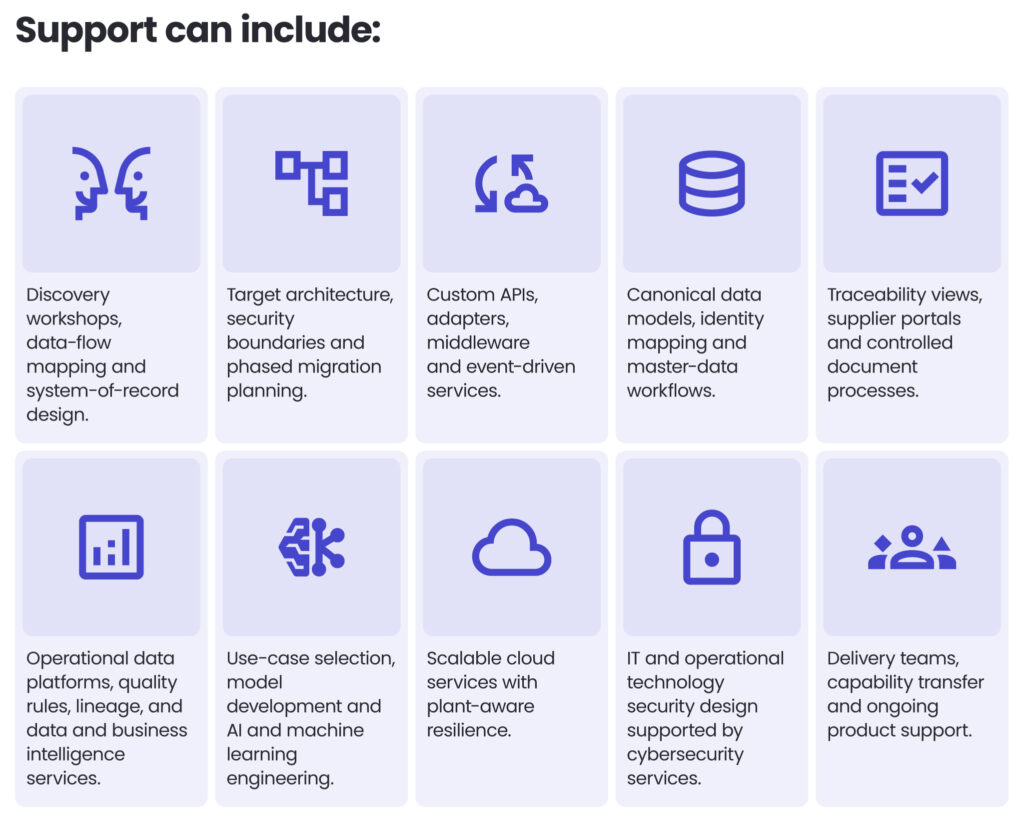
The first engagement should produce decisions. A useful architecture assessment identifies the priority business slice, systems, and owners involved, current data risks, target integration patterns, security constraints, supplier implications, Scope 1 and Scope 3 data needs, delivery backlog, and acceptance KPIs.
The output should also state what not to build. Some interfaces can remain controlled batch exchanges. Some local systems should be retired. Some AI ideas should wait until labels improve. A credible partner both narrows the programme and delivers it.
Food processing system integration: sum up, and the practical next step
Food processors do not become AI-ready by replacing every application or copying all data into one platform. They become ready by defining ownership, connecting operational events, preserving lineage, and governing the way data is corrected, shared, and used. ERP, MES, LIMS, WMS, and QMS can remain in place when their responsibilities are clear, and their interfaces are supportable.
The same food processing system integration foundation can serve several priorities: batch genealogy, release control, supplier collaboration, Scope 1 and Scope 3 evidence, analytical reporting, and AI. That reuse is the core business case. It reduces duplicated work and makes future changes less dependent on individual systems or spreadsheets.
The next step is an integration architecture assessment centred on one business-critical flow. As Spyrosoft, we can map your current process, define the target data contracts, and identify a first vertical slice that delivers an operational result, all while building reusable foundations for the wider programme. Contact us via the form below and see what we can do for you.
Selected sources and standards
- Regulation (EC) No 178/2002, Article 18, General Food Law traceability requirements, EUR-Lex.
- ISA-95 and IEC 62264, enterprise-control system integration standards.
- GS1, EPCIS and Core Business Vocabulary 2.0.
- GHG Protocol, Corporate Value Chain (Scope 3) Accounting and Reporting Standard.
- Commission Delegated Regulation (EU) 2023/2772, ESRS E1-6 on gross Scope 1, Scope 2, Scope 3 and total greenhouse gas emissions.
- Directive (EU) 2026/470 and European Commission guidance of 6 May 2026 on the CSRD value-chain cap.
- OPC Foundation, OPC Unified Architecture Part 1; OASIS, MQTT Version 5.0.
- NIST, Artificial Intelligence Risk Management Framework 1.0.
- ISO/IEC 42001:2023, artificial intelligence management systems.
FAQ
Usually not. The first task is to define which system owns each business object and event, then connect those systems through governed interfaces. ERP replacement is justified when the platform is unsupported, unsafe, unable to expose required data, or unable to support the operating model. Otherwise, integration normally delivers earlier value with lower migration risk.
There is no single duration because site count, vendor access, data quality, and process scope vary. For planning purposes, a focused discovery can be time-boxed to 8–12 weeks, followed by a vertical-slice delivery. The useful planning unit is a business flow, such as release-to-dispatch or incoming-material approval, rather than a promise to connect every system at once.
The organisation should own an enterprise batch identity, while individual systems may retain local identifiers where technical constraints require them. A governed mapping links ERP, MES, LIMS, WMS, and supplier references. The crucial control is that every split, merge, transformation, and rework event preserves the relationship between enterprise and local identities.
No. A data lake provides storage, not reliable meaning. AI requires stable identities, event time, source lineage, labels, feature availability at decision time, quality controls and feedback on outcomes. The analytical platform should consume governed operational events and reference data. It should not become a substitute for correcting weak source processes.
It should collect only the information needed for the defined procurement, quality, traceability, or sustainability decisions. Typical items include onboarding data, certificates, specifications, delivery information, corrective actions, and selected emissions activity data. Requirements should vary by supplier and material risk. Every submission needs validation, versioning, status, and an internal approval owner.
Often yes. Options include vendor APIs, OPC UA, MQTT gateways, database views, change data capture, and controlled file exchange. The decision depends on supportability, latency, and security. A legacy adapter should translate data into a stable contract and isolate the old system. Integration is not appropriate if the source is unsafe or cannot produce reliable records.
Store operational activity separately from emission factors and calculation outputs. Scope 1 records should link fuel, refrigerant, and controlled-asset activity to source evidence. Scope 3 records should link procurement, supplier, transport, packaging, and waste activities to a category, method, and factor version. This structure supports recalculation, assurance, and method improvement.
Use least-privilege service identities, encryption, certificate and secret rotation, network segmentation, schema validation, logging, monitoring, backup and tested recovery. Plant-critical flows need local continuity and clear fallback. Remote supplier or cloud access should never create unrestricted routes into operational technology. Security ownership must continue after the initial implementation.
Choose replacement when the core system is beyond support, presents an unmanageable security risk, cannot support required processes or interfaces, or costs more to contain than to migrate. The decision should include data migration, plant continuity, validation, training, and decommissioning. Replacement should solve a demonstrated structural problem, not serve as a substitute for governance.


arrow_circle_rightContact us
Let’s discuss how we can help you with your agritech projects

arrow_circle_right Other articles


