On-premise AI that analyses every call – without exposing a single personal record
Spyrosoft developed a fully on-premise AI call centre analyser that processes raw conversations in real-time, surfaces actionable business insights, and flags potential fraud – running entirely on a single local machine, Lenovo ThinkStation PGX.

Services
Technologies

Challenge and business need
Call centres in regulated industries (banking, insurance, healthcare) contain valuable signals: customer frustration, unresolved claims, repeated complaints, and sometimes coordinated fraud. Yet turning these signals into actionable insights is far from straightforward.
While organisations have access to this data, using it effectively is resource-intensive and often limited by anonymisation and compliance constraints.
This is because call centres also handle large volumes of sensitive customer data, such as policy numbers, national IDs, and addresses. As a result, organisations have had to rely either on manual quality analysis or on cloud AI providers.
Both paths carry significant problems:
- Manual quality assurance covers only a small fraction of total call volume and cannot realistically detect cross-call fraud patterns.
- Routing calls through a cloud AI provider requires sending raw personal data to external servers, which is a significant compliance risk under GDPR.
The question Spyrosoft set out to answer was: can a local, on-premise AI model reach sufficient quality to be a viable alternative?
Our role
Spyrosoft designed a solution around a central architectural decision: keep everything on the hardware, instead of relying on external APIs.
We identified that most data compliance challenges can be avoided if data is handled locally. Until recently, this approach was not feasible. However, the emergence of powerful local GPU machines (such as Lenovo ThinkStation PGX) created a breakthrough. This allowed our team to deploy an open-source large language model directly onto the device.
Why this approach?
- No data leaves the premises
- No anonymisation or external dependency is required
- Cost-efficiency (one-time infrastructure investment vs. recurring fees)
The resulting platform – the call centre analyser – provides three core capabilities:
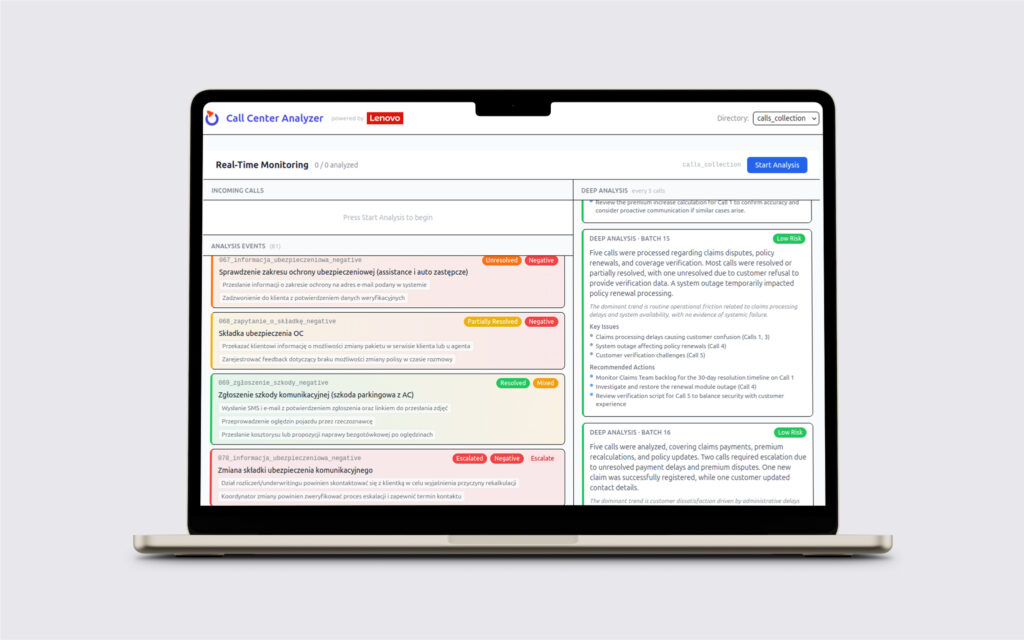
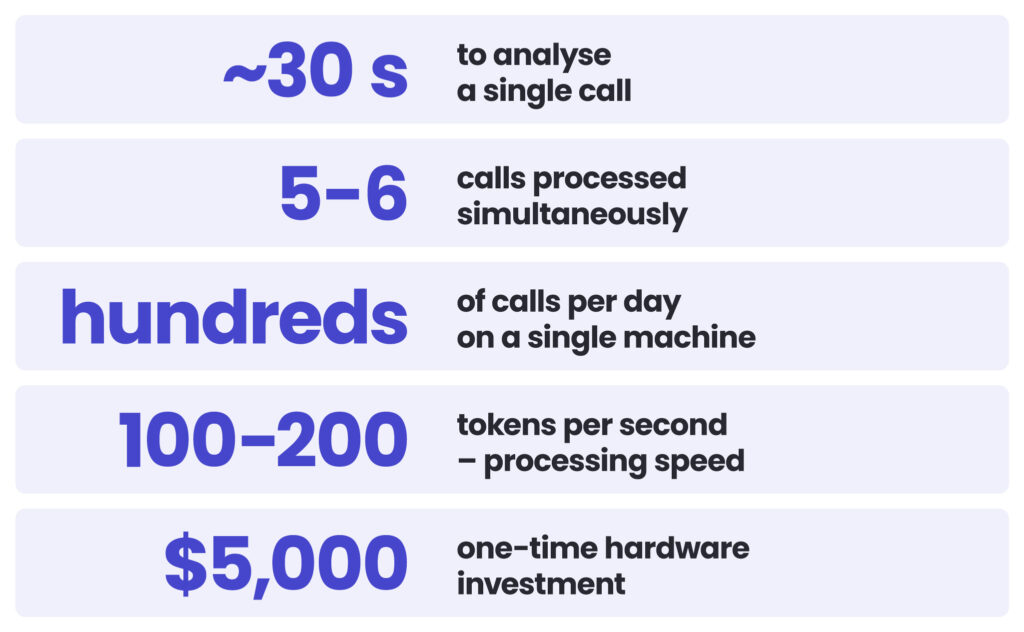
- Per-call analysis – each conversation is processed in approx. 30 seconds, producing a structured output: summary, customer intent, sentiment score, extracted personal and policy data, suggested agent actions, and keyword tags.
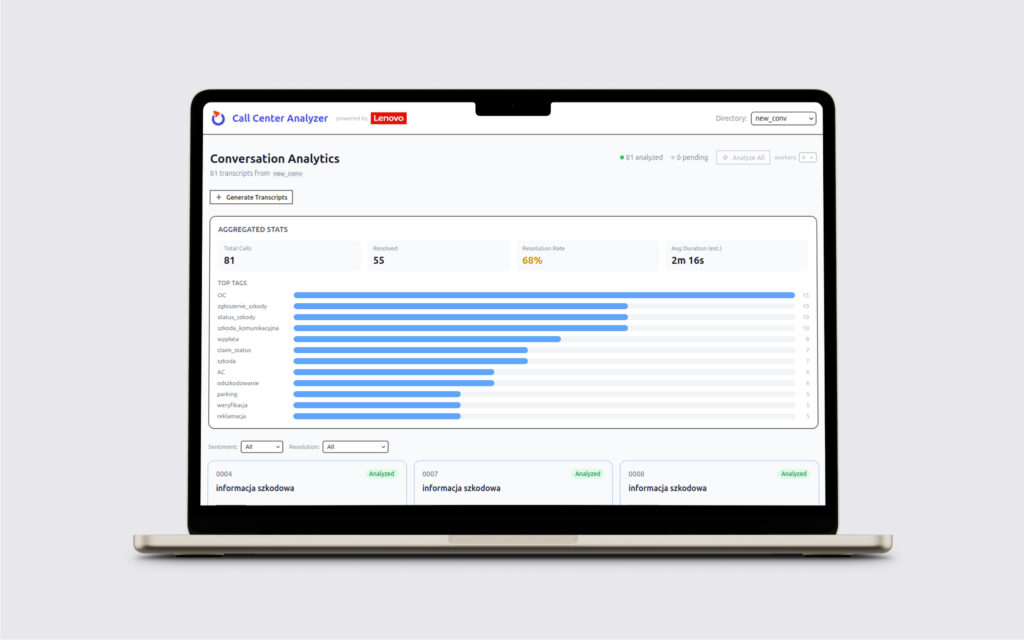
- Real-time monitoring dashboard – five to six calls are analysed in parallel, with live statistics on resolution rates, call topics, and sentiment. Supervisors can filter them to identify problem areas.
- Deep analysis and fraud detection – the system runs batch-level analysis across groups of calls, automatically flagging suspicious patterns (e.g. multiple seemingly unrelated claims referencing the same address or contact details, submitted by different policyholders to different agents). Batch-level analysis also enables various business perspectives – such as analysing all calls handled by a specific agent, comparing top-performing agents with the long tail, or identifying recurring issues within specific call types.
A single machine handles hundreds of calls per day. The hardware cost is approximately $5,000 as a one-time investment, with no recurring API fees. The only ongoing costs are electricity and standard IT maintenance.
arrow_circle_right Testimonial
From our expert
The AI identified a suspicious pattern across multiple, seemingly unrelated calls – concerning different policyholders and different claims. Those connections would have been nearly impossible to catch manually.

The result
The working demo demonstrates that, with current bandwidth, a single Lenovo ThinkStation PGX can support a medium-sized call centre, delivering the following outcomes and benefits:
- Predictable cost model: a one-time hardware investment replaces recurring costs, regardless of call volume.
- Full data sovereignty: sensitive customer data never leaves the organisation’s infrastructure, eliminating anonymisation overhead and data exposure risk.
- Operational intelligence for leadership: every call produces structured output that supervisors can act on immediately, without reviewing individual recordings.
- Fraud detection: automated cross-call pattern recognition surfaces coordinated fraud attempts that manual review would be unlikely to catch.
arrow_circle_right Testimonial
Others about us
arrow_circle_right OUR WORK
See other success stories of our clients


arrow_circle_rightContact us
Let’s talk about your use case

Tomasz Smolarczyk
Director of Artificial Intelligence