A new chapter for Spyrosoft’s Cracow office: An interview with Zbigniew Marfiak


Zbigniew has recently taken on the role of Site Manager at Spyrosoft’s Cracow office, bringing with him a clear vision for the future. With a focus on strengthening collaboration, accelerating growth and nurturing a strong team culture, he is ready to guide the office into its next phase.
In this interview, he discusses his priorities, anticipated challenges, and plans for aligning people, processes, and technology. Read on to find out how Zbigniew’s approach could influence the direction of Spyrosoft in Cracow.
What were your first impressions of the Cracow site, especially in terms of the technologies and types of projects being delivered here?
When I joined Spyrosoft five years ago, my first impression was, to be honest, one of positive shock. Having come from a traditional automotive company that was largely focused on legacy technologies, I had not fully anticipated encountering such a concentration of experts working with the latest tools and architectures. Immediately apparent were not only the technical depth and breadth of competencies, but also the fact that these extended far beyond a single industry.
In one location alone, world-class expertise was evident in cloud platforms, AI and data, distributed systems, mobile applications and large-scale banking and financial systems delivered to global markets. This was complemented by strong cybersecurity capabilities and a proven ability to deliver projects in highly regulated environments, establishing Spyrosoft as a mature engineering hub from the outset, capable of handling complex, business-critical systems.
What are your main priorities as a Site Manager, and what challenges are you currently facing?
As a Site Manager, my main priority is to continuously strengthen Cracow’s position as a mature engineering hub that delivers real business value, rather than just capacity. To achieve this, I focus on three core areas.
Firstly, I focus on people and competencies, ensuring that our teams develop senior-level skills and strong domain expertise in key areas such as automotive, enterprise, HMI, robotics, and renewable energy. The goal is to build teams that understand the technology, the business, and the regulatory context in which our systems operate. Secondly, delivery quality and technological relevance – ensuring that the projects reflect the direction in which the market is heading. This includes modern engineering practices, cloud-native platforms, the pragmatic use of AI to enhance productivity and quality, and robust security measures, particularly in regulated environments. Thirdly, focus on long-term sustainability by building stable, resilient teams, maintaining flexibility during market fluctuations and aligning local growth with Spyrosoft’s long-term strategy.
The main challenge is to manage this evolution responsibly in a more mature and selective IT market. Clients increasingly expect consulting-level expertise and measurable business outcomes, while engineers look for meaningful, high-quality work and clear development paths. Another challenge is to keep pace with rapid technological change, particularly around AI, while ensuring that it is adopted thoughtfully and embedded into everyday engineering processes rather than being treated as a trend. I see these as an opportunities, because they encourage us to be more focused and intentional, and ultimately make stronger as a Cracow site and as part of the total Spyrosoft organisation.

What is your vision for the site’s future, and which areas are you particularly focused on developing?
My vision for Spyrosoft Cracow’s future is to establish the site as a strategic partner for the most demanding industries, renowned for its exceptional expertise, consistently high performance, and outstanding delivery quality. A key part of this vision involves adopting AI as a practical, everyday capability that measurably improves the quality and efficiency of software development. Currently, we are focusing intensely on integrating AI into our engineering processes to increase productivity, enhance consistency, reinforce testing and documentation, and ultimately deliver superior software more efficiently and reliably.
At the same time, we are determined to combine this efficiency gain with the highest standards required in regulated environments. We are deliberately evolving towards projects in sectors such as medical devices, renewable energy, critical infrastructure and defence, where compliance, security, traceability and reliability are non-negotiable. We aim to demonstrate that AI-supported development can be compatible with rigorous engineering discipline and regulatory readiness.
Looking ahead, I envisage the site growing in terms of its impact. I expect to see a steadily expanding group of senior consultants and domain experts who provide real advisory value to clients, supporting architecture decisions, regulatory alignment, and long-term technology strategy in the most demanding of domains. Under this model, Cracow’s office will be recognised as a trusted partner that combines deep domain knowledge, modern engineering practices, and cutting-edge AI tooling to deliver high-quality software projects where failure is simply not an option.
How has the project profile and technological focus of the Cracow office evolved recently?
In recent years, the Cracow site has shifted towards more advanced, value-driven and technology-intensive projects spanning multiple industries. In the automotive sector, for example, we have largely moved away from legacy C-based development in favour of modern C++ solutions, higher-level architectures, and system integration. Our teams now focus on areas such as autonomous driving and advanced HMI built using the Qt framework, particularly for premium brands. At the same time, AI tools have become an integral part of our daily work, supporting coding, testing and documentation.
Medical projects are now a key pillar of our portfolio. We develop software for life-supporting and life-saving devices, for which the highest standards of reliability and regulatory compliance are required. We also deliver advanced geospatial systems, including mobile and web applications for large-scale map analysis, which are used by public institutions across Europe.
In the enterprise sector, we combine strong cloud-native expertise with growing AI adoption and are increasingly acting as a long-term strategic partner, focusing on scalable platforms and business value.
Codibly, part of the Spyrosoft Group, is an important contributor to our capabilities. Its expertise in renewable energy and electromobility, covering standards such as OCPP, OCPI, OpenADR and IEEE 2030.5, strengthens our position in energy and sustainability projects. At the same time, close collaboration with other Spyrosoft offices, particularly with regard to our global partnership with Qt, provides our team with early access to new technologies and opportunities to develop high-impact software solutions.
Can you share examples of projects or challenges that best reflect the diversity and complexity?
A good way to illustrate the diversity and complexity of the work delivered with strong involvement from the Cracow site is to look at a few representative projects from very different domains.
An example comes from the geospatial domain in the form of work carried out for the UK’s Ordnance Survey. Our teams have contributed to the development, modernisation and ongoing evolution of the OS Maps ecosystem here, which includes native mobile applications, a web platform, a custom map-printing service and the cloud backend that powers the entire solution. The platform serves more than one million active users and boasts over three million registered accounts worldwide, and operates under demanding performance, reliability and scalability requirements.
The project’s complexity stems from the need to support a wide range of real-world scenarios, from offline navigation in remote areas to seasonal traffic spikes and ensuring long-term compatibility with map content purchased years ago. The solution meets these challenges by combining an offline-first architecture, resilient cloud infrastructure and a sophisticated geospatial data layer that standardises diverse datasets for routing and network analysis.
A very different example that highlights another dimension of complexity is a project led by Codibly in the electromobility and renewable energy sector. The project is focused on implementing a comprehensive solution for managing a network of electric vehicle charging stations. This includes a CPMS (Charge Point Management System) for monitoring, controlling and operating the charging infrastructure, as well as an eMSP (eMobility Service Provider) platform to support end users accessing and using the charging network. The project involves complex integrations with hardware devices, energy systems and external partners, as well as handling large volumes of real-time data relating to billing, availability and load management. Operating at the intersection of mobility, energy markets and regulation makes this work especially demanding, as it requires the use of industry-standard protocols to ensure interoperability, scalability and compliance across different regions and regulatory frameworks.
How does collaboration between Spyrosoft and Codibly teams work in practice?
The collaboration between the Spyrosoft and Codibly teams has matured significantly, and today they work as a well-integrated, complementary model. Initially, as with most integrations, there were differences in working styles, methodologies, and organisational habits. Over time, however, these were aligned through close cooperation, shared standards, and joint delivery experience. The teams now operate seamlessly, with clear roles and a strong sense of mutual trust.
From Codibly’s perspective, becoming part of the Spyrosoft Group has brought tangible benefits. Codibly has gained strong organisational backing, access to a broader technological ecosystem, and the ability to tap into a shared pool of highly skilled engineers when projects require additional scale or specific competencies. The integration also provides mature support in areas common to modern software delivery, such as DevOps practices, cloud and infrastructure services, and cybersecurity. This allows teams to focus more on delivering value to clients, while back-office and operational processes are handled by the wider group.
At the same time, Codibly has deliberately preserved and strengthened its core strengths. The company remains deeply focused on its core expertise in renewable energy and electromobility, developing proprietary software products and delivering certified, bespoke solutions for complex energy ecosystems. Codibly teams continue to lead in areas such as grid to assets connectivity protocols, charging infrastructure, grid and demand response programmes integration and energy management systems, while leveraging the wider Group’s capabilities where appropriate.
In practice, this means a balanced model – Codibly retains a high level of autonomy and domain leadership while benefiting from Spyrosoft’s scale, maturity, and cross-domain expertise. For clients, this translates into solutions that combine in-depth, specialised energy expertise with the reliability, security and delivery standards of a larger technology organisation.
How would you describe the culture of the office, and what is most important to you as a leader?
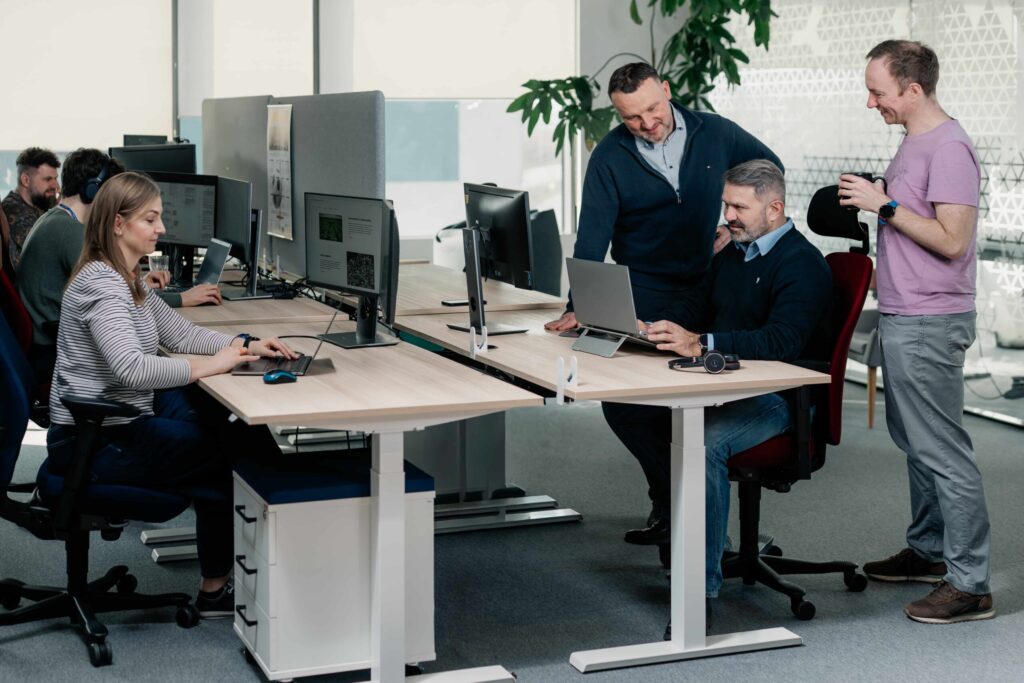
The culture of the office is truly distinctive. It is a place where people genuinely enjoy working together and feel connected to their work. It is particularly telling that employees come to the office willingly, even though they are not formally obliged to do so. This speaks volumes about the atmosphere we have built, which is based on trust, meaningful collaboration, and a shared sense of purpose. Teams here are highly engaged and aligned around common goals, motivated by the impact of their work.
A strong element of our culture is the drive to grow and learn. The people are naturally curious and eager to work with the latest technologies, especially at a time of true revolution in software engineering, driven by modern AI tools. There is a clear awareness that software development will never be the same again, and many colleagues want to shape this change rather than just react to it. They value the opportunity to experiment responsibly, improve engineering practices, and influence the direction of technology and the industry. At the same time, this culture is grounded in a strong focus on quality and responsibility. The most important thing is to deliver robust, well-engineered solutions and be fully prepared to meet the stringent requirements of critical and regulated industries. This mindset is deeply embedded in how teams think and work, from design and development to testing and validation.
As a leader, maintaining this balance is most important to me: fostering an environment in which people feel inspired, trusted and empowered to innovate, while also safeguarding the discipline, quality focus and professional standards required for our most demanding projects. My role is to create conditions that enable talented individuals to produce meaningful, technically excellent work that has a real impact in areas where reliability and quality matter most.
As a final question, could you share a bit more about your personal journey to becoming the Site Manager and what motivated you to take on this role?
Becoming the Site Manager was a natural progression from my previous experience. I spent many years working in the automotive industry, collaborating closely with engineering teams on projects that demanded the highest standards of quality, precision and discipline. This background has had a lasting impact on my approach to software development and responsibility.
When I joined Spyrosoft five years ago, I initially focused on building teams and supporting complex projects. Over time, I became increasingly involved in shaping the overall operations of the Cracow site, which gradually expanded my role. Taking on the role of Site Manager felt like a natural progression, driven by my desire to create an environment where engineers can grow and collaborate effectively to deliver reliable solutions in challenging and meaningful areas.
If this approach resonates with you and you’re looking for a place where your expertise can truly make an impact, or where you can grow into that level – this is a good moment to take a closer look. Explore our open roles at Spyrosoft Cracow and see where your experience and ambitions could fit within the team!


arrow_circle_right Contact us
Thinking about your next step in tech?
We’re always open to working with best-in-class experts.
Send us your CV, and we’ll contact you when there’s a new job opening that matches your skillset and experience.
arrow_circle_right Other articles