Cloud for FinTech: how switching to AWS let TakTo be more flexible


Moving faster than your competitors is hard when your infrastructure can’t keep up. Cloud is one of the few options that lets you cut spending and add capability and resources exactly when you need them.
One of the industries where this technology is just emerging is financial services. Due to the recent influx of accessible and secure cloud services, adoption in the sector is picking up quickly.
That wasn’t the case even a few years ago.
Why financial services companies are turning to cloud
For years, the instability and underdevelopment of legacy systems kept the financial industry stuck in its ways. Pen and paper, alongside enormous mainframes and applications, underpinned the running of financial services businesses. The public cloud was treated as something you simply didn’t trust with financial data.
And financial executives weren’t the only ones with doubts. Customers expected banking and financial services to be reliable and secure. They also justifiably expected all transactions and activities to happen in real-time, without delays in approval. The technology was urgently needed, and all providers were racing to develop a feasible solution.
In addition to the barriers above, EU and US financial regulations were also blockers to cloud adoption. But the resistance didn’t only come from regulators.
Some banks used the legal requirements as an excuse to avoid switching to more innovative services. The overall regulatory environment wasn’t ready for the digital transformation.
That changed in 2016, particularly evident in European markets, with the UK and Poland among the countries where legislative changes happened early on. In the UK, the Financial Conduct Authority, which is the regulator for almost 60,000 financial firms, released a guide to using cloud services. The document clearly stated that these services are safe use in banking if data hosting and security are ‘appropriately considered’. The revolution could begin.
The guide wasn’t the only push.
Other factors followed, including statements from the Information Commissioner’s Office and the Bank of England’s Prudential Regulation Authority. Regulators, and financial industry professionals, finally recognised that cloud services were already in regular use in other fields that handle sensitive data.
The IT industry as a whole was also getting better at risk assessment.
Once these documents were published, the word got out: innovation in the financial industry is not only possible – it is inevitable.
The technical solutions soon followed. One of the services that started being used widely in the financial sector for building secure IT infrastructure and systems was AWS (Amazon Web Services).
Add the financial pressure that followed 2020, and the case for cloud only got stronger.
Cloud services for the financial industry: why and how did TakTo switch to AWS?
Let’s take a closer look at how we used AWS in the cloud migration project for one of our clients, TakTo, using our status as an AWS Gold Partner.
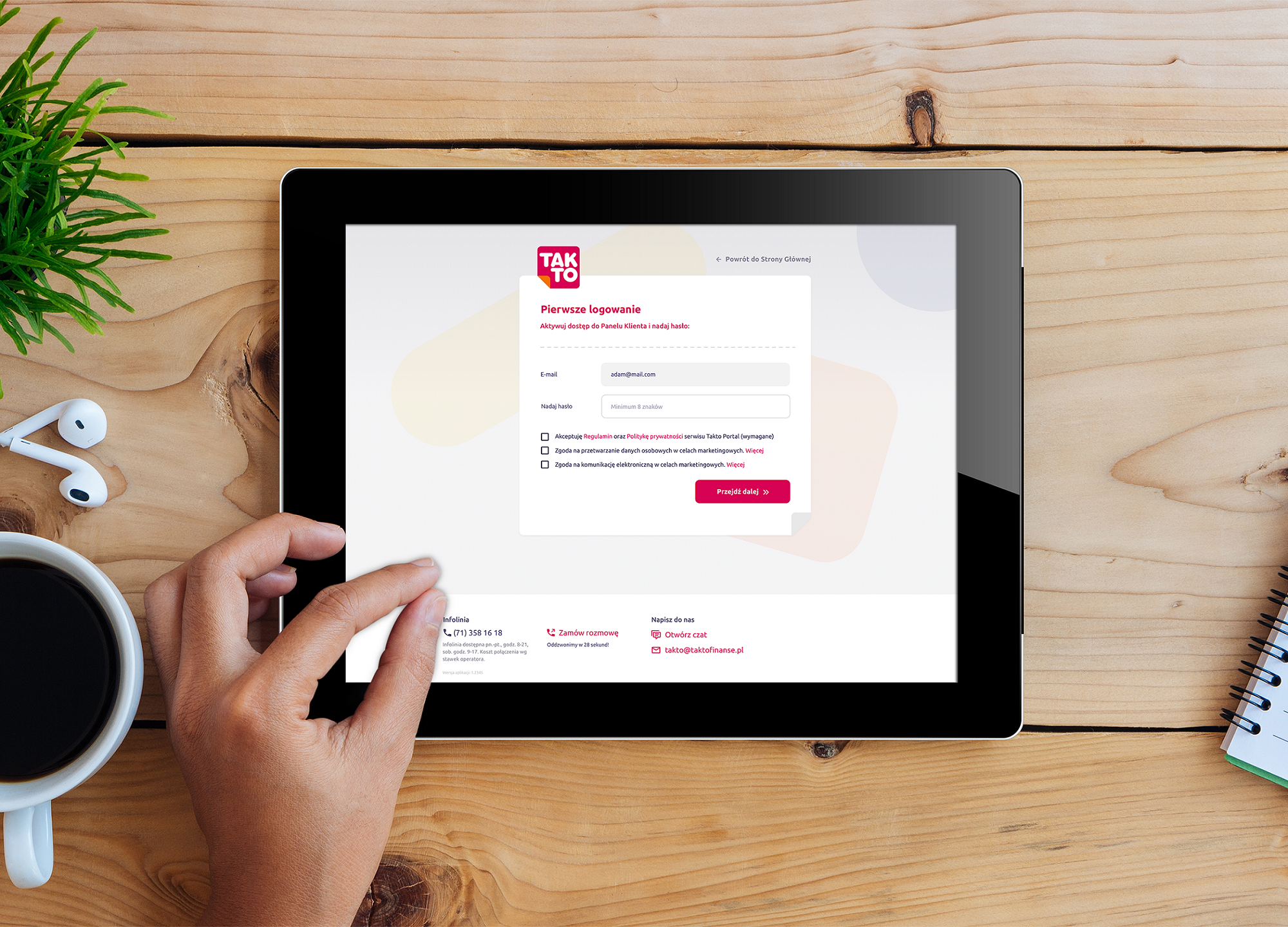
TakTo is a financial company based in Wroclaw, Poland. Its customers take out loans through an online chat and repay them through a dedicated customer platform.
Founded in 2012, the company follows ethical conduct principles and the Best Practices Guide issued by the Association of Financial Companies in Poland (ZPF).
For years, TakTo ran its servers from a physical site outside its headquarters, maintaining and scaling them by hand. As the company grew, that became a problem – the team needed easier access.
The space itself was also costly and had to be kept in optimal condition. Technical staff were employed to look after the machines. The ageing infrastructure needed near-constant investment.
Our team at Spyrosoft reviewed the requirements and the options available, and concluded that designing and building new cloud infrastructure was the way forward.

What are the benefits of using cloud services?
Reliability
Virtual servers set up on AWS are fast and hold up under load. Amazon’s data centres are spread around the world, and once you upload your data, it is split across several secure locations. So one failed component doesn’t take your data with it.
Scalability
You can also scale up the number of virtual servers hosting your application or database as your customer numbers grow. The whole process can be automated – and even if it isn’t, it takes just a few clicks. With physical machines, you’d have to buy and set them up before any expansion was possible.
Security
AWS Infrastructure-as-a-Service also lets us add automation scripts to almost every element of the architecture and track changes, following continuous integration and continuous deployment practices. With AWS, we can also easily set up backup and disaster recovery procedures.
Flexibility & cost saving
Each AWS service is billed individually and per hour, so we can turn virtual devices on and off as needed – and pass the savings on to our client.
Virtual servers lets us save money because we can switch them on and off when necessary, or even add new instances within minutes. The solution is also highly flexible, which in turn allows our team to act faster and shorten the time to market for new services.
Dagmara Majdak, Head of Project Development at TakTo
Customisability
There are almost no setup restrictions when it comes to customising AWS services. When working for TakTo, we could choose the operating system, database, and programming language, as well as other components. The tooling is also straightforward to pick up, so our developers could focus on building the right setup for the client rather than learning the platform.
New to cloud computing? Get the fundamentals before you commit.
Read the guide
What does the AWS migration process look like?
Let’s get back to TakTo’s migration. As straightforward as it sounds, the whole process required meticulous planning, paired with detailed architecture decisions and continuous testing. TakTo is also a 24/7 business, so its customers had to be able to use the application without interruption at any point. The change had to be completely invisible on the customer side – thousands of people visit TakTo’s website each day.
The migration therefore ran in stages. We also took a ‘lift and shift’ approach, where the whole process is completed with little to no changes to the applications themselves. We began by transferring and testing smaller, non-customer-facing databases and environments.
We’d set up the virtual servers and the infrastructure, and then dive into the application. Once all smaller and more reliable elements were transferred, we could start mocking them on production and testing how the whole system works.
Marcin Szremski, a DevOps specialist on the team handling the migration.
 The final stage focused on TakTo’s databases, which were extensive and, from a technical point of view, the trickiest element to move to Amazon’s virtual servers. All data was secured in advance through a series of backup transfers, so Spyrosoft’s team could access and upload it quickly if any service didn’t behave as expected.
This final stage of the infrastructure migration was completed over the course of an evening, with the whole team working in shifts. Each stage was assigned to a different developer, so once they received an ‘all clear’ from one person, they could proceed with their part.
With the final migration complete, the team finished the project three weeks before the deadline. It was also invisible to TakTo’s end customers, whose activity was unaffected throughout.
As a result, TakTo no longer runs physical servers and can add virtual machines on demand. Being able to turn certain environments on and off is also a significant advantage of AWS. ‘This lets us save money when we’re not using these environments. The solution is also highly flexible, which in turn allows our team to act faster and shorten the time to market for new services’, says Dagmara Majdak, Head of Project Development at TakTo. Mateusz Gralak, who worked as project manager on the Spyrosoft side, adds: ‘By working with AWS servers, we’ve been able to help TakTo get to the next level and join the leaders of the Polish financial market.’
The Spyrosoft team now handles the maintenance and keeps the application running smoothly, using the automated monitoring tools we introduced during the migration.
What does the future hold for cloud services?
Expect more of this in the years ahead. Customers will keep pushing to stay in sync and online at all times, and that pressure isn’t going anywhere. At the same time, many companies are under real strain on resources and funding, and need to transform their business quickly to keep up.
At Spyrosoft, we’re ready to apply our approach and our experience to your cloud project. If your infrastructure is holding you back, let’s talk about what a migration would look like for you.
We’re really satisfied with how the migration projects are carried out and that’s definitely the direction we want to explore more going forward. We already have a list of customers who are asking for similar solutions to be implemented for their financial infrastructure.
Sławomir Podolski, the Financial Services Business Unit director at Spyrosoft.







Take full advantage of cloud solutions. Contact our expert to discuss your needs.

Marcin Zyga
Chief AI & Information Officer